When the Cure is Worse than the Disease: Paterson, A City in the Crosshairs of the 1980s Drug Crisis
“La Cura Resulta Más Mala Que La Enfermedad”: Paterson, A City in the Crosshairs of the 1980s Drug Crisis
by Anthony Rivera
Site Description:
The mid-sized city has been lost in narrative, grouped alongside the larger metros like Chicago, Los Angeles, and New York; its voice has been drowned out in the broader discussion of deindustrialization and drug abuse in the built environment. Paterson is one such city that has been grouped in multiple ways within the orbit of the metros; I believe that Paterson can provide a much-needed perspective on the aforementioned dominant narrative. I seek to answer the following questions: In what ways has Paterson been affected by spatial disinvestment, and where is it placed among the established narrative of the mid-sized city? What connections are there between spatial disinvestment and the drug crisis of the 1980s? In what ways does Paterson’s urban environment act as a space for the reflection of broader narratives about the drug crisis? My aim is to discuss the built environment and its abandonment as an incubation of the drug crisis. Through Paterson, I will demonstrate how the inner city reflects an aspect of the cycle of capitalism: abandonment through exacerbated catastrophe.
Lorem ipsum dolor sit amet, consectetur adipiscing elit, sed do eiusmod tempor incididunt ut labore et dolore magna aliqua. Ut enim ad minim veniam, quis nostrud exercitation ullamco laboris nisi ut aliquip ex ea commodo consequat. Duis aute irure dolor in reprehenderit in voluptate velit esse cillum dolore eu fugiat nulla pariatur. Excepteur sint occaecat cupidatat non proident, sunt in culpa qui officia deserunt mollit anim id est laborum.
Lorem ipsum dolor sit amet, consectetur adipiscing elit, sed do eiusmod tempor incididunt ut labore et dolore magna aliqua. Ut diam quam nulla porttitor massa id. Elementum facilisis leo vel fringilla est ullamcorper eget nulla. Orci porta non pulvinar neque laoreet suspendisse interdum. Purus semper eget duis at tellus at urna. Diam maecenas ultricies mi eget mauris. Diam ut venenatis tellus in metus vulputate eu. Ullamcorper morbi tincidunt ornare massa eget egestas. Quis eleifend quam adipiscing vitae proin. Consectetur adipiscing elit pellentesque habitant. Cras fermentum odio eu feugiat pretium nibh ipsum consequat nisl. Lectus mauris ultrices eros in cursus turpis massa. Luctus accumsan tortor posuere ac. Porttitor eget dolor morbi non arcu. Maecenas pharetra convallis posuere morbi leo urna molestie. Neque convallis a cras semper auctor neque vitae. In iaculis nunc sed augue. Suspendisse interdum consectetur libero id faucibus. Sit amet porttitor eget dolor.
Felis eget nunc lobortis mattis aliquam faucibus. At elementum eu facilisis sed odio. Eu facilisis sed odio morbi quis commodo odio aenean sed. Habitasse platea dictumst quisque sagittis purus sit amet. Et ultrices neque ornare aenean euismod elementum nisi quis eleifend. Velit dignissim sodales ut eu sem integer. Morbi tempus iaculis urna id volutpat lacus laoreet non curabitur. Aliquam eleifend mi in nulla posuere sollicitudin aliquam. Nunc congue nisi vitae suscipit. Convallis tellus id interdum velit laoreet id. Turpis in eu mi bibendum neque egestas. Magna fermentum iaculis eu non diam phasellus vestibulum. In cursus turpis massa tincidunt dui ut ornare lectus sit.
Non pulvinar neque laoreet suspendisse. Eros donec ac odio tempor orci. Nullam non nisi est sit amet facilisis magna etiam tempor. Platea dictumst vestibulum rhoncus est pellentesque elit ullamcorper. Eleifend donec pretium vulputate sapien nec sagittis aliquam. Proin fermentum leo vel orci porta. Eget dolor morbi non arcu risus quis varius quam quisque. Nec ultrices dui sapien eget mi proin sed. Nisl nisi scelerisque eu ultrices vitae auctor eu augue. Pellentesque pulvinar pellentesque habitant morbi tristique senectus et netus et. Pellentesque habitant morbi tristique senectus et. Pulvinar elementum integer enim neque volutpat ac. Vel orci porta non pulvinar neque. Laoreet sit amet cursus sit amet.
Pharetra massa massa ultricies mi quis hendrerit dolor magna. Mattis nunc sed blandit libero volutpat. Nec ultrices dui sapien eget. Gravida neque convallis a cras semper auctor neque. Aenean et tortor at risus viverra adipiscing at. Quisque non tellus orci ac auctor augue mauris. Ultrices in iaculis nunc sed augue lacus. Quam elementum pulvinar etiam non. Felis bibendum ut tristique et egestas. Sagittis nisl rhoncus mattis rhoncus. Ac ut consequat semper viverra. Volutpat commodo sed egestas egestas fringilla phasellus faucibus scelerisque. Urna condimentum mattis pellentesque id nibh tortor. Erat nam at lectus urna duis convallis convallis. Malesuada fames ac turpis egestas sed tempus urna et pharetra. Pellentesque diam volutpat commodo sed egestas egestas. Interdum velit euismod in pellentesque massa placerat duis ultricies lacus. Est velit egestas dui id. Pellentesque id nibh tortor id aliquet lectus proin nibh. Id nibh tortor id aliquet lectus proin nibh nisl.
Primary Sources:
Part I. Primary Source List:
Clark, Joe and Joe Picard. Laying Down The Law: Joe Clark’s Strategy For Saving Our Schools.
Washington, D.C.: Regnery Gateway, 1989.
Location: Link.
Joe Clark was the principal of Easide High School during the early 1980s. His accounts provide a view of students and the school environment that he was tasked with fixing for the state exams.
Office of the Attorney General. “Uniform Crime Reports, State of New Jersey 1980.”
Collections: Uniform Crime Reports, Trenton, 1980.
http://hdl.handle.net/10929/23105
Location: New Jersey State Library.
A crime report that indicates criminal statistics for the year 1980. An anchor for the beginning of the decade for comparison and critical analysis.
Office of the Attorney General. “Uniform Crime Reports, State of New Jersey 1985.”
Collections: Uniform Crime Reports, Trenton, 1985.
http://hdl.handle.net/10929/23110
Location: New Jersey State Library.
A 1985 crime report indicates upward trends in crime. Compared to 1980, there are notable increases in drug-related crime and a notable shift in drug types.
Office of the Attorney General. “Uniform Crime Reports, State of New Jersey 1989.”
Collections: Uniform Crime Reports, Trenton, 1989.
http://hdl.handle.net/10929/23114
Location: New Jersey State Library.
A 1989 crime report that presents end-of-decade statistics. Drug-related crime has shown notable changes since 1980 and 1985; it shows that narcotics and opioids have become the most reported drug crimes.
Kramer, Lawrence F., Oral History Project, Interviewed by Barbara Krasner. Paterson-Great
Falls National Historical Park, August 11, 2015.
OHP Pat Kramer – Paterson Great Falls National Historical Park (U.S. National Park Service)
Location: Paterson-Great Falls National Historical Park.
An interview with Lawrence Francis “Pat” Kramer (1933-2023), former mayor of Paterson who served four three-year terms, 1967-1973 and 1975-1982. Serves as a glimpse into Paterson’s administration; however, Kramer seems to avoid pressing questions and instead focuses on his accomplishments.
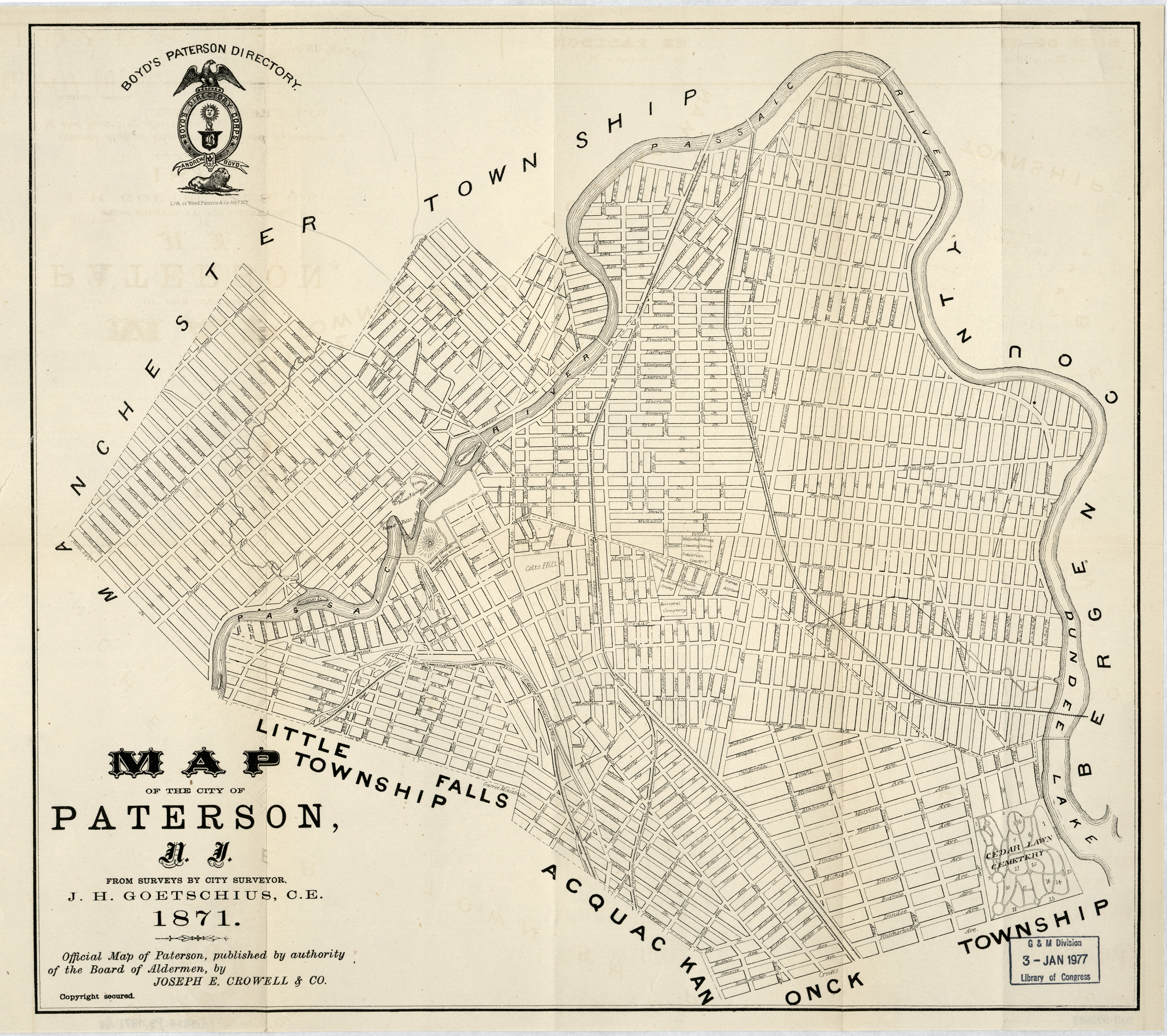
Joseph E. Crowell & Co. Map of the city of Paterson. Accessed from the Library of Congress.
- Map. https://geography.rutgers.edu/images/NJ_Historical_Maps/PASSAIC_COUNTY/PATERSON/Paterson_1871.jpg
Location: Rutgers University New Brunswick Historical Maps.
A map that shows the streets and rail lines of Paterson. This shows the legacy of industrialization, albeit desperately enshrined in Paterson’s spirit.
Reagan, Ronald. State of the Union Address to Congress. January 26, 1982. United States
Capitol, Washington, D.C. Reagan Library YouTube. https://youtu.be/BikZU-mzxjM?si=MF2E-A6TmhE7rujX
Location: Reagan Library YouTube Channel.
President Reagan’s State of the Union Address to the U.S. Congress in 1982. Here is where Reagan advocated for his “New Federalism” policies impacting communities.
Reagan, Ronald. Speech to the National League of Cities. March 2, 1981. Washington Hilton
Hotel, Washington, D.C. Reagan Library YouTube. https://youtu.be/pDkbW7_u7bQ?si=Q3rdVZxgVSjW9olc
Location: Reagan Library YouTube Channel.
The first of many speeches to the National League of Cities, a group of city officials who represent the interests of their municipalities. President Reagan discusses the need for a federal spending rollback and pushes social spending back to the state level. “Cures were developed for which there were no known diseases.”
“Omnibus Budget Reconciliation Act of 1981: Titles III, VI, IX, XI, XXVI.” Public Law, United
States, 1981.
https://www.govinfo.gov/content/pkg/COMPS-10576/pdf/COMPS-10576.pdf
Location: Reagan Library.
The legislative backbone of President Reagan’s “New Federalism” initiative. This legislation restructures municipal grants, shifting more control to state capitals.
“The States and Distressed Communities: The Final Report.” Commission Report, United States,
https://library.unt.edu/gpo/acir/Reports/policy/a-101.pdf
Location: UNT University Libraries.
A report by the Advisory Commission on Intergovernmental Relations serves as a snapshot of the period 1980-1983, demonstrating significant demographic changes. This provides invaluable information about the economic needs of communities.
Part II. Primary Source Analysis
President Ronald Reagan is a polarizing figure in American history. Serving for most of the 1980s, the Reagan administration addressed issues such as fiscal conservatism, federalism, and urban policy, taking a conservative stance on most matters. Ultimately, his administration is remembered for the limited federal government presence in American lives. We see a glimpse of President Reagan’s controversial tenure in his March 2, 1981, speech at the Washington Hilton Hotel to the National League of Cities. From this speech, it can be argued that the Reagan administration’s advocacy of “New Federalism” in the early 1980s set a precedent for limited government spending and presence, exacerbating the decline of built-environment relations vis-à-vis Paterson.
The first and most notable aspect of the source is President Reagan’s language and diction. He linked unemployment, inflation, and the cost of living with federal oversight, framing it as the source of struggle. President Reagan portrays federalism as the force that prevents the economy from moving forward, giving the sentiment that the government is suffocating the American people. The agitation leads to his “New Federalism” policy, where President Reagan changes tone. This resuscitation gives him more leverage in his solution. Drawing on his personal experience as California governor and easing criticism, he was able to swiftly pivot to what his administration would cut back on while also empowering state governments. This sets the framework for his tenure and the government’s approach regarding the mid-size city.
President Reagan can be quoted as saying, “Cures were developed for which there were no known diseases.” This is an important moment in the speech where he identifies the reason for the ballooning budget. The President argues that the previous administrations poured money into issues that seemingly did not exist. They prepared the government for the possibility of crisis when there was none. Interestingly, President Reagan argues that urban maintenance, such as pothole filling, falls within that category. Rather than maintaining the built environment, the President proposes that building infrastructure is the better alternative. This quote also reframes what economic revitalization will look like, not as the conservation of communities, but as restructuring them alongside progress. A question can be raised: what will progressive restructuring look like?
The final and most powerful aspect of President Reagan’s speech is legacy. The legacy of industrial spaces is one of the louder parts of the President’s speech, even though it is spoken about very little. Yet legacy is one of the motivating factors for the Reagan administration in revitalizing the American economy. This brings us to an important part of the paper: memory and how we decide to remember history. Paterson, like other mid-sized industrial spaces, enshrines its industrial legacy in the built environment with plaques and museums that place heavy emphasis on its industrial triumph in pre-WWII America. It marginalizes the history that follows, which shapes the dynamics of modern Paterson. There needs to be a revisionist approach when looking at the histories of industrial mid-sized cities, rather than idolizing the built environment that catered to white people. We must accept that the industrialized economy was a closed system that only benefited the dominant race while also alienating undesired races. Deindustrialization was not an unprecedented shortcoming but part of the cycle of capitalism, in which the closed system moved with the dominant race while abandoning the undesirables.
Secondary Sources:
Lassiter, Matthew D. The Suburban Crisis White America and the War on Drugs.
New Jersey: Princeton University Press, 2023.
https://a.co/d/059BJsJi
A comparative case study between suburban and urban spaces to discuss the war on drugs within the context of the suburban environment through youths. Lassiter does this through three key stages: fear of urban and foreign “pushers,” placing marijuana and LSD in their own drug categories to prosecute the “real criminals” in urban centers, and coercive campaigns in suburban areas for rehabilitation and militarized interdiction in nonwhite urban areas. This study provided a basis for understanding the differences between urban and suburban areas and for examining attitudes toward the drug crisis. Paterson is surrounded by suburban spaces like those in Bergen County and cities like Wayne and Clifton. Understanding why there were two different approaches to the drug epidemic will help frame why the urban environment was connected with crime.
McLean, Katherine. “‘There’s nothing here’: Deindustrialization as risk environment for
overdose.” International Journal of Drug Policy, vol. 29 (2016): 19-26. Accessed
October 17, 2026. 10.1016/j.drugpo.2016.01.009
“There’s nothing here”: Deindustrialization as risk environment for overdose – ScienceDirect
McLean applies the “risk environment” in her study regarding drug overdoses in the deindustrialized region of the Monongahela Valley in Pennsylvania. This study conducts interviews with people who have experienced or witnessed an overdose and then connects it with the culture of drug abuse in the area. The focus on the environment as a criterion for overdose risk offers a different perspective from my study, as it shifts the lens slightly away from purely economic reasoning toward a connection between environment and behavior. It helps raise questions about the spatiality of drug abuse in Paterson and how it possibly affected people’s behavior.
McCubbins, Amanda. “American Drug Story: How Racialized Media Depictions of Drug Crises
Shape Policy Agendas.” Master thesis, Arizona State University, May 2020. Accessed October 17, 2026.
https://login.proxy.libraries.rutgers.edu/login?qurl=https%3A%2F%2Fwww.proquest.com%2Fdissertations-theses%2Famerican-drug-story-how-racialized-media%2Fdocview%2F2408511458%2Fse-2%3Faccountid%3D13626
McCubbins’ study looks into the relationship between media coverage and the impact it had on policy regarding the drug crisis, the crack epidemic, and the opioid crisis. She tracks periodicals and news coverage and their intended audiences from 1986 to the 2000s to extract information about race, class, policy, and social construction (in which people are categorized as deviant/criminal or deserving/patient). This study addresses a weakness in my study: how keywords such as “crack,” “epidemic,” or even “city” are used to mark people and environments. By bridging this gap, my study will provide a deeper understanding of why the inner-city urban environment was portrayed as it was.
Murch, Donna. “Crack In Los Angeles: Crisis, Militarization, and Black Response to the Late
Twentieth-Century War on Drugs.” Journal of American History, vol. 102, issue 1 (June
2015): 162-173. Accessed October 17, 2026.
https://doi-org.proxy.libraries.rutgers.edu/10.1093/jahist/jav260
Crack in Los Angeles: Crisis, Militarization, and Black Response to the Late Twentieth-Century War on Drugs | Journal of American History | Oxford Academic
Murch addresses the challenge for scholarship on the drug crisis, where the aim is to “disentangle the social history of drug use, informal economy, and poverty from law-and-order narratives rationalizing punitive campaigns.” Using Los Angeles as a case study, Murch seeks to draw attention to African Americans and their resistance to the hypermilitarization of police and to establishing community aid groups to help drug abusers and to address the carceral state. While the study took place in a larger city than Paterson, it provides insight into a community response to the drug crisis and policing that took place. It raises questions about the possible community response that occurred in Paterson to address what was done in response to the drug crisis.
Owusu, Thomas Y. “Economic Transition in the City of Paterson, New Jersey (America’s First
Planned Industrial City): Causes, Impacts, and Urban Policy Implications.” Urban
Studies Research, vol. 2014 (2014). Accessed October 17, 2026.
DOI:10.1155/2014/672794
https://login.proxy.libraries.rutgers.edu/login?qurl=https%3A%2F%2Fwww.proquest.com%2Fscholarly-journals%2Feconomic-transition-city-paterson-new-jersey%2Fdocview%2F1561940042%2Fse-2%3Faccountid%3D13626
Thomas Y. Owusu examines the “dynamics of economic change” in Paterson from its founding up to 1990. This ambitious undertaking allows for a broader understanding of Paterson’s economy from its founding as America’s first industrial city to its unique economic decline despite its population growth. Owusu argues that Paterson now serves as a labor-supply site rather than a place of work, drawing on surrounding markets, such as malls and New York City, to sustain it. This acts as an environmental analysis of the labor market: how the removal industry was relocated to surrounding suburbs and larger cities like New York, thus creating the commuter culture we now see.
Robinson, Cedric J. Black Marxism The Making of the Black Radical Tradition.
London: Zed Press, 1983. Reprinted by University of North Carolina Press, 2000.
https://a.co/d/0aso0tRc
A book about the concept of “Black Radicalism,” where Robinson seeks to frame capitalism as a closed system for Europeans in which it created racial fabrications. In chapter 5, “The Atlantic Slave Trade and African Labor,” Robinson provides the framework that capitalism has always relied on a racial hierarchy in which it exploited Africans for European gains, leading to the abandonment of groups and spaces once the cycle of capitalism ends. This framework helps capture the African American labor experience during the collapse of Paterson’s industry and the conditions they were left with in the lead-up to the 1980s. I aim to take Paterson out of the dominant narrative of industrial decline leading to the “tragedy” of the drug crisis; I seek to frame Paterson as a feature of the cycle of capitalism’s nature to exploit racial groups, then abandon them, leading to social decline wherein it constructed the basis for the drug crisis.
Sugrue, Thomas J. The Origins of the Urban Crisis Race and Inequality in Postwar Detroit.
New Jersey: Princeton University Press, 2005.
https://a.co/d/0j95F1u3
The book provides a basis for analyzing mid-sized industrial cities, in which Sugrue uses economic and spatial context to discuss the onset of urban inequality, using Detroit as the subject of his study. It addresses the unresolved problems of capitalism as a vehicle for inequality and the fact that African Americans historically bore the inequality that it generated. Origins of the Urban Crisis helps my project by providing much-needed background on the history of mid-sized cities in the Rust Belt, which is essential for discussing the onset of urban poverty in cities that were once economic powerhouses. Paterson was once known as “Silk City,” where textiles and industry defined northern New Jersey alongside Newark; this book provides the background needed to understand the decline of the mid-sized city and to grasp the racial experience during this period.
Urban decay and the drug epidemics have been studied and discussed extensively. Recurring themes include environmental racism, sociocultural effects of deindustrialization, and the wider implications of the war on drugs and its effects on people of color. The literature uses case studies of larger industrialized cities such as Los Angeles, Chicago, and New York to trace the decline of urban centers from the mid-20th century to the present, with these problems still persisting in some communities. The focal point of each case study centers on state-community power dynamics and how community groups manage to push back against inequality while also facing the challenges of drug abuse.
However, the aforementioned case studies are a methodological limitation of the current field. Major cities are often used to reflect broader themes and national trends. This study reorients the focus away from primary metropolises toward mid-sized urban centers like Paterson and discusses the effects of spatial disinvestment, in which these spaces bore the brunt of deindustrialization and served as sacrificial zones for the reallocation of funding to other areas. In doing so, I seek to expand the work of Thomas J. Sugrue to include Paterson, whose historiography is extremely dated and, like that of many other cities, flattened into standard narratives of deindustrialized tragedy.
Image Analysis:
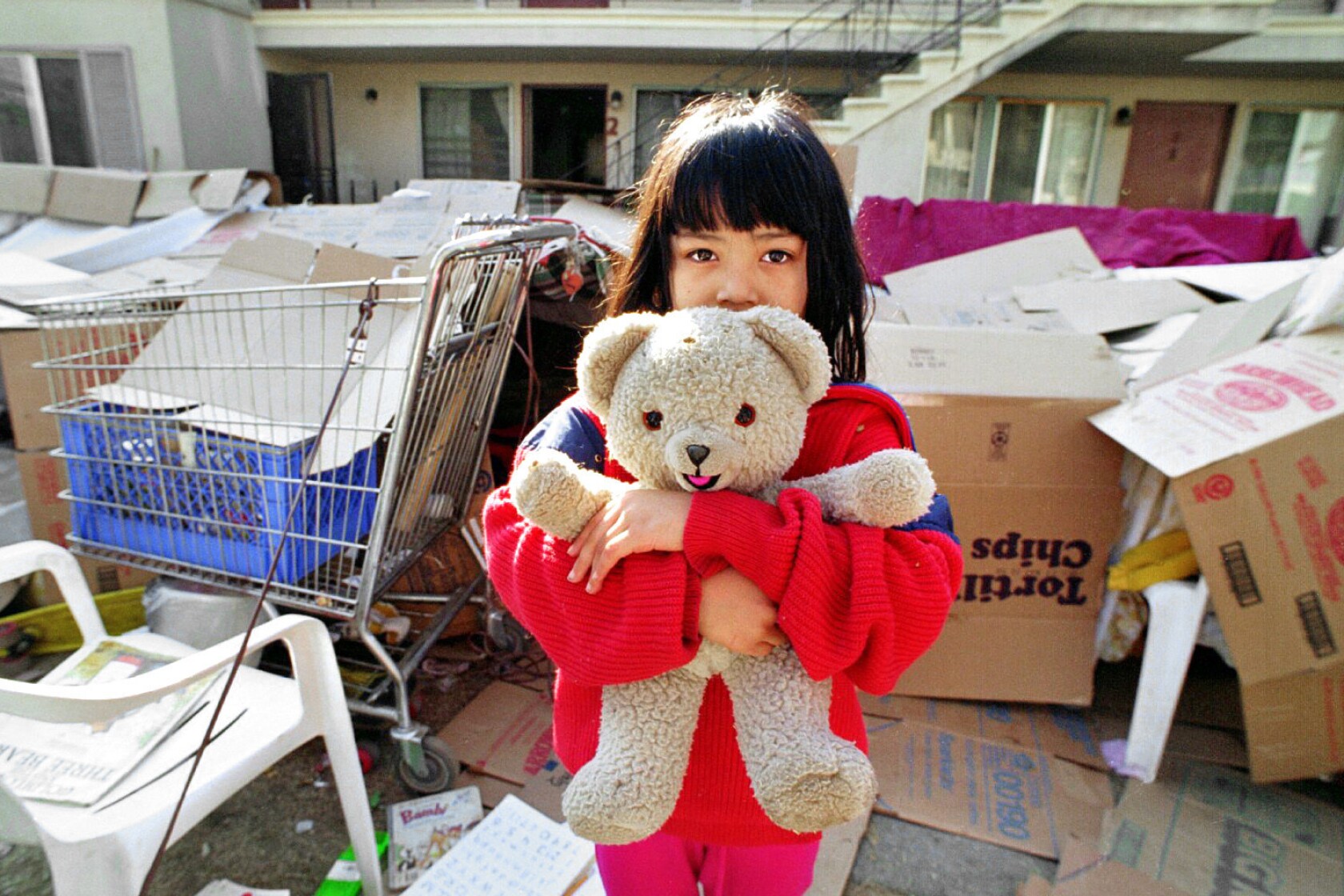
Lorem ipsum dolor sit amet, consectetur adipiscing elit, sed do eiusmod tempor incididunt ut labore et dolore magna aliqua. Ut diam quam nulla porttitor massa id. Elementum facilisis leo vel fringilla est ullamcorper eget nulla. Orci porta non pulvinar neque laoreet suspendisse interdum. Purus semper eget duis at tellus at urna. Diam maecenas ultricies mi eget mauris. Diam ut venenatis tellus in metus vulputate eu. Ullamcorper morbi tincidunt ornare massa eget egestas. Quis eleifend quam adipiscing vitae proin. Consectetur adipiscing elit pellentesque habitant. Cras fermentum odio eu feugiat pretium nibh ipsum consequat nisl. Lectus mauris ultrices eros in cursus turpis massa. Luctus accumsan tortor posuere ac. Porttitor eget dolor morbi non arcu. Maecenas pharetra convallis posuere morbi leo urna molestie. Neque convallis a cras semper auctor neque vitae. In iaculis nunc sed augue. Suspendisse interdum consectetur libero id faucibus. Sit amet porttitor eget dolor.
Felis eget nunc lobortis mattis aliquam faucibus. At elementum eu facilisis sed odio. Eu facilisis sed odio morbi quis commodo odio aenean sed. Habitasse platea dictumst quisque sagittis purus sit amet. Et ultrices neque ornare aenean euismod elementum nisi quis eleifend. Velit dignissim sodales ut eu sem integer. Morbi tempus iaculis urna id volutpat lacus laoreet non curabitur. Aliquam eleifend mi in nulla posuere sollicitudin aliquam. Nunc congue nisi vitae suscipit. Convallis tellus id interdum velit laoreet id. Turpis in eu mi bibendum neque egestas. Magna fermentum iaculis eu non diam phasellus vestibulum. In cursus turpis massa tincidunt dui ut ornare lectus sit.
Non pulvinar neque laoreet suspendisse. Eros donec ac odio tempor orci. Nullam non nisi est sit amet facilisis magna etiam tempor. Platea dictumst vestibulum rhoncus est pellentesque elit ullamcorper. Eleifend donec pretium vulputate sapien nec sagittis aliquam. Proin fermentum leo vel orci porta. Eget dolor morbi non arcu risus quis varius quam quisque. Nec ultrices dui sapien eget mi proin sed. Nisl nisi scelerisque eu ultrices vitae auctor eu augue. Pellentesque pulvinar pellentesque habitant morbi tristique senectus et netus et. Pellentesque habitant morbi tristique senectus et. Pulvinar elementum integer enim neque volutpat ac. Vel orci porta non pulvinar neque. Laoreet sit amet cursus sit amet.
Pharetra massa massa ultricies mi quis hendrerit dolor magna. Mattis nunc sed blandit libero volutpat. Nec ultrices dui sapien eget. Gravida neque convallis a cras semper auctor neque. Aenean et tortor at risus viverra adipiscing at. Quisque non tellus orci ac auctor augue mauris. Ultrices in iaculis nunc sed augue lacus. Quam elementum pulvinar etiam non. Felis bibendum ut tristique et egestas. Sagittis nisl rhoncus mattis rhoncus. Ac ut consequat semper viverra. Volutpat commodo sed egestas egestas fringilla phasellus faucibus scelerisque. Urna condimentum mattis pellentesque id nibh tortor. Erat nam at lectus urna duis convallis convallis. Malesuada fames ac turpis egestas sed tempus urna et pharetra. Pellentesque diam volutpat commodo sed egestas egestas. Interdum velit euismod in pellentesque massa placerat duis ultricies lacus. Est velit egestas dui id. Pellentesque id nibh tortor id aliquet lectus proin nibh. Id nibh tortor id aliquet lectus proin nibh nisl.
Consequat semper viverra nam libero justo laoreet sit. Ornare massa eget egestas purus viverra accumsan in. Dignissim diam quis enim lobortis scelerisque fermentum dui faucibus in. Curabitur gravida arcu ac tortor dignissim convallis aenean et tortor. Erat nam at lectus urna duis convallis convallis tellus. Risus at ultrices mi tempus imperdiet nulla malesuada pellentesque elit. Turpis egestas maecenas pharetra convallis posuere morbi leo. Nulla facilisi etiam dignissim diam quis enim lobortis. Pellentesque massa placerat duis ultricies. Est ante in nibh mauris cursus. Massa sed elementum tempus egestas sed sed risus. Augue ut lectus arcu bibendum at varius. Neque viverra justo nec ultrices dui sapien eget mi proin. Non diam phasellus vestibulum lorem sed risus ultricies. Venenatis cras sed felis eget velit aliquet sagittis id consectetur. Tristique et egestas quis ipsum suspendisse. Facilisis volutpat est velit egestas dui. Non nisi est sit amet facilisis magna. Scelerisque mauris pellentesque pulvinar pellentesque habitant morbi tristique senectus. Bibendum at varius vel pharetra vel turpis nunc.