
Salem’s Lot(s): Land Inequality and the Moravian Church in Antebellum Salem, North Carolina
by Ben Caine
Site Description:
Tracing its roots back to the 15th century Bohemian Hussite Church, (the oldest Protestant Church) the Moravian Church was represented in the Piedmont in the 18th Century by a community of a few hundred Eastern European German-speaking settlers and over a hundred enslaved Black people called (then just) Salem. Like other communities in the region at the time, the town subsisted primarily through agriculture, and profited extensively from early tobacco cultivation. Unlike other communities in the region at this time, Salem lacked both a civil authority and private land ownership: in both cases, the institution of the Church, organized by the Congregation, supplanted these structures. In Salem, community members were bound to be in good standing with the Church, and to live lives of Christian virtue, and in exchange, were granted ‘leases.’ These leases, distributed by Church leadership, entitled one to work, collect resources from, and build improvements upon a determined parcel of land (called a lot). Ownership over these things was maintained by the holder, unless they were to fall out of favor with the Church, in which case they would be compensated and instructed to leave the community. This project seeks to understand the relationship between this unique property distribution regime and the local environment to determine how assigned lot locations were reflections of an individual’s community standing, and how the ecological quality of that lot may have in turn affected their place in that hierarchy. I believe this research could serve as a significant case study for understanding the role of land access in the formation of class structures in the early American South.
Lorem ipsum dolor sit amet, consectetur adipiscing elit, sed do eiusmod tempor incididunt ut labore et dolore magna aliqua. Ut enim ad minim veniam, quis nostrud exercitation ullamco laboris nisi ut aliquip ex ea commodo consequat. Duis aute irure dolor in reprehenderit in voluptate velit esse cillum dolore eu fugiat nulla pariatur. Excepteur sint occaecat cupidatat non proident, sunt in culpa qui officia deserunt mollit anim id est laborum.
Lorem ipsum dolor sit amet, consectetur adipiscing elit, sed do eiusmod tempor incididunt ut labore et dolore magna aliqua. Ut diam quam nulla porttitor massa id. Elementum facilisis leo vel fringilla est ullamcorper eget nulla. Orci porta non pulvinar neque laoreet suspendisse interdum. Purus semper eget duis at tellus at urna. Diam maecenas ultricies mi eget mauris. Diam ut venenatis tellus in metus vulputate eu. Ullamcorper morbi tincidunt ornare massa eget egestas. Quis eleifend quam adipiscing vitae proin. Consectetur adipiscing elit pellentesque habitant. Cras fermentum odio eu feugiat pretium nibh ipsum consequat nisl. Lectus mauris ultrices eros in cursus turpis massa. Luctus accumsan tortor posuere ac. Porttitor eget dolor morbi non arcu. Maecenas pharetra convallis posuere morbi leo urna molestie. Neque convallis a cras semper auctor neque vitae. In iaculis nunc sed augue. Suspendisse interdum consectetur libero id faucibus. Sit amet porttitor eget dolor.
Felis eget nunc lobortis mattis aliquam faucibus. At elementum eu facilisis sed odio. Eu facilisis sed odio morbi quis commodo odio aenean sed. Habitasse platea dictumst quisque sagittis purus sit amet. Et ultrices neque ornare aenean euismod elementum nisi quis eleifend. Velit dignissim sodales ut eu sem integer. Morbi tempus iaculis urna id volutpat lacus laoreet non curabitur. Aliquam eleifend mi in nulla posuere sollicitudin aliquam. Nunc congue nisi vitae suscipit. Convallis tellus id interdum velit laoreet id. Turpis in eu mi bibendum neque egestas. Magna fermentum iaculis eu non diam phasellus vestibulum. In cursus turpis massa tincidunt dui ut ornare lectus sit.
Non pulvinar neque laoreet suspendisse. Eros donec ac odio tempor orci. Nullam non nisi est sit amet facilisis magna etiam tempor. Platea dictumst vestibulum rhoncus est pellentesque elit ullamcorper. Eleifend donec pretium vulputate sapien nec sagittis aliquam. Proin fermentum leo vel orci porta. Eget dolor morbi non arcu risus quis varius quam quisque. Nec ultrices dui sapien eget mi proin sed. Nisl nisi scelerisque eu ultrices vitae auctor eu augue. Pellentesque pulvinar pellentesque habitant morbi tristique senectus et netus et. Pellentesque habitant morbi tristique senectus et. Pulvinar elementum integer enim neque volutpat ac. Vel orci porta non pulvinar neque. Laoreet sit amet cursus sit amet.
Pharetra massa massa ultricies mi quis hendrerit dolor magna. Mattis nunc sed blandit libero volutpat. Nec ultrices dui sapien eget. Gravida neque convallis a cras semper auctor neque. Aenean et tortor at risus viverra adipiscing at. Quisque non tellus orci ac auctor augue mauris. Ultrices in iaculis nunc sed augue lacus. Quam elementum pulvinar etiam non. Felis bibendum ut tristique et egestas. Sagittis nisl rhoncus mattis rhoncus. Ac ut consequat semper viverra. Volutpat commodo sed egestas egestas fringilla phasellus faucibus scelerisque. Urna condimentum mattis pellentesque id nibh tortor. Erat nam at lectus urna duis convallis convallis. Malesuada fames ac turpis egestas sed tempus urna et pharetra. Pellentesque diam volutpat commodo sed egestas egestas. Interdum velit euismod in pellentesque massa placerat duis ultricies lacus. Est velit egestas dui id. Pellentesque id nibh tortor id aliquet lectus proin nibh. Id nibh tortor id aliquet lectus proin nibh nisl.
Primary Sources:
Lorem ipsum dolor sit amet, consectetur adipiscing elit, sed do eiusmod tempor incididunt ut labore et dolore magna aliqua. Ut diam quam nulla porttitor massa id. Elementum facilisis leo vel fringilla est ullamcorper eget nulla. Orci porta non pulvinar neque laoreet suspendisse interdum. Purus semper eget duis at tellus at urna. Diam maecenas ultricies mi eget mauris. Diam ut venenatis tellus in metus vulputate eu. Ullamcorper morbi tincidunt ornare massa eget egestas. Quis eleifend quam adipiscing vitae proin. Consectetur adipiscing elit pellentesque habitant. Cras fermentum odio eu feugiat pretium nibh ipsum consequat nisl. Lectus mauris ultrices eros in cursus turpis massa. Luctus accumsan tortor posuere ac. Porttitor eget dolor morbi non arcu. Maecenas pharetra convallis posuere morbi leo urna molestie. Neque convallis a cras semper auctor neque vitae. In iaculis nunc sed augue. Suspendisse interdum consectetur libero id faucibus. Sit amet porttitor eget dolor.
Felis eget nunc lobortis mattis aliquam faucibus. At elementum eu facilisis sed odio. Eu facilisis sed odio morbi quis commodo odio aenean sed. Habitasse platea dictumst quisque sagittis purus sit amet. Et ultrices neque ornare aenean euismod elementum nisi quis eleifend. Velit dignissim sodales ut eu sem integer. Morbi tempus iaculis urna id volutpat lacus laoreet non curabitur. Aliquam eleifend mi in nulla posuere sollicitudin aliquam. Nunc congue nisi vitae suscipit. Convallis tellus id interdum velit laoreet id. Turpis in eu mi bibendum neque egestas. Magna fermentum iaculis eu non diam phasellus vestibulum. In cursus turpis massa tincidunt dui ut ornare lectus sit.
Non pulvinar neque laoreet suspendisse. Eros donec ac odio tempor orci. Nullam non nisi est sit amet facilisis magna etiam tempor. Platea dictumst vestibulum rhoncus est pellentesque elit ullamcorper. Eleifend donec pretium vulputate sapien nec sagittis aliquam. Proin fermentum leo vel orci porta. Eget dolor morbi non arcu risus quis varius quam quisque. Nec ultrices dui sapien eget mi proin sed. Nisl nisi scelerisque eu ultrices vitae auctor eu augue. Pellentesque pulvinar pellentesque habitant morbi tristique senectus et netus et. Pellentesque habitant morbi tristique senectus et. Pulvinar elementum integer enim neque volutpat ac. Vel orci porta non pulvinar neque. Laoreet sit amet cursus sit amet.
Pharetra massa massa ultricies mi quis hendrerit dolor magna. Mattis nunc sed blandit libero volutpat. Nec ultrices dui sapien eget. Gravida neque convallis a cras semper auctor neque. Aenean et tortor at risus viverra adipiscing at. Quisque non tellus orci ac auctor augue mauris. Ultrices in iaculis nunc sed augue lacus. Quam elementum pulvinar etiam non. Felis bibendum ut tristique et egestas. Sagittis nisl rhoncus mattis rhoncus. Ac ut consequat semper viverra. Volutpat commodo sed egestas egestas fringilla phasellus faucibus scelerisque. Urna condimentum mattis pellentesque id nibh tortor. Erat nam at lectus urna duis convallis convallis. Malesuada fames ac turpis egestas sed tempus urna et pharetra. Pellentesque diam volutpat commodo sed egestas egestas. Interdum velit euismod in pellentesque massa placerat duis ultricies lacus. Est velit egestas dui id. Pellentesque id nibh tortor id aliquet lectus proin nibh. Id nibh tortor id aliquet lectus proin nibh nisl.
Consequat semper viverra nam libero justo laoreet sit. Ornare massa eget egestas purus viverra accumsan in. Dignissim diam quis enim lobortis scelerisque fermentum dui faucibus in. Curabitur gravida arcu ac tortor dignissim convallis aenean et tortor. Erat nam at lectus urna duis convallis convallis tellus. Risus at ultrices mi tempus imperdiet nulla malesuada pellentesque elit. Turpis egestas maecenas pharetra convallis posuere morbi leo. Nulla facilisi etiam dignissim diam quis enim lobortis. Pellentesque massa placerat duis ultricies. Est ante in nibh mauris cursus. Massa sed elementum tempus egestas sed sed risus. Augue ut lectus arcu bibendum at varius. Neque viverra justo nec ultrices dui sapien eget mi proin. Non diam phasellus vestibulum lorem sed risus ultricies. Venenatis cras sed felis eget velit aliquet sagittis id consectetur. Tristique et egestas quis ipsum suspendisse. Facilisis volutpat est velit egestas dui. Non nisi est sit amet facilisis magna. Scelerisque mauris pellentesque pulvinar pellentesque habitant morbi tristique senectus. Bibendum at varius vel pharetra vel turpis nunc.
Secondary Sources:
Annotated Bibliography:
2. Christopher E. Hendricks. “‘And Will You There a City Build’: The Moravian Congregation Town and the Creation of Salem, North Carolina.” Buildings & Landscapes: Journal of the Vernacular Architecture Forum 20, no. 2 (2013): 77–101. https://doi.org/10.5749/buildland.20.2.0077 .
Annotation: In this article, Hendricks provides a precise analysis of the architectural techniques and city-planning methods used by Moravian settlers in Salem, NC, in the 18th Century. In this analysis, he indicates that this archetypal Moravian settlement structure embodies the ‘congregation town form,’ a social and infrastructural system that Hendricks explains is instrumental to understanding internal settlement politics. This article will be instrumental in my final project, as Hendricks’ analysis offers substantial insight into the man-made elements of this location.
2. Sommer, Elisabeth. “A Different Kind of Freedom? Order and Discipline among the Moravian Brethren in Germany and Salem, North Carolina 1771-1801.” Church History 63, no. 2 (1994): 221–34. https://doi.org/10.2307/3168589 .
Annotation: In this article, Sommer outlines the contradiction between Anglo-American liberal perceptions of political ‘freedom’ and the Brethren’s concept of ‘spiritual freedom.’ This work offers insight into the ideological framework through which the Moravian settlers established their town’s social system, and it also provides a possible model for tracing the lives of certain individuals through Church archives.
3. Shirley, Michael. “The Market and Community Culture in Antebellum Salem, North Carolina.” Journal of the Early Republic 11, no. 2 (1991): 219–48. https://doi.org/10.2307/3123241 .
Annotation: In this article, Shirley outlines the slow collapse and eventual abolition of the congregational system in Salem, North Carolina. It highlights an immediate contrast between the Brethren’s espoused communal values and the commercial incentives of the emerging 18th-century market economy in the American South. This work offers insight into how material concerns immediately disrupted this community’s egalitarian aspirations, while also providing the macroeconomic context in which this project occurred.
4. Africa, Philip. “Slaveholding in the Salem Community, 1771-1851.” The North Carolina Historical Review 54, no. 3 (1977): 271–307. http://www.jstor.org/stable/23529858 .
Annotation: In this work, Africa analyzes how the ever-intensifying reality of Plantation Slavery destabilized the Moravian community and led to the eventual collapse of the congregational system. Herein, Africa explains how the lucrative wealth generation of slaveholding became a more attractive lifestyle proposition than radical protestant communalism. This work offers insight into the role that enslaved Black individuals played in this community, and how their role in the economy served to create hierarchical outcomes within the white community.
5. Bynum, Flora Ann L. 1996. “Old World Gardens in the New World: The Gardens of the Moravian Settlement of Bethabara in North Carolina, 1753–72.” The Journal of Garden History 16 (2): 70–86. doi:10.1080/14601176.1996.10435638
Annotation: In this work, Bynum analyzes the continuity of traditional Central European garden cultivation practices in the community of Bethabara, North Carolina. Like Salem, Bethabara was a predominantly Moravian settlement, located today in the same municipality: Winston-Salem. This work serves as a useful comparative model for understanding the Salem settlers’ relationship with the land and their methods of sustenance.
6. Wiethaus, Ulrike, and Grant Profant McAllister, eds. Moravian Americans and Their Neighbors, 1772–1822. Leiden: Brill, 2023. https://doi.org/10.1163/9789004517868
Annotation: This book includes work by several leading scholars on early Moravian settlement in the Southeastern United States, providing access to what should be the cutting edge of scholarship. Moreover, rather than focusing only on the experiences of white settlers or Black slaves, this text includes local indigenous perspectives on the establishment of Moravian settlements, offering vital support for building a comprehensive understanding of the wider social context in which Salem existed.
7. Thomas, Brian W. “Inclusion and Exclusion in the Moravian Settlement in North Carolina, 1770-1790.” Historical Archaeology 28, no. 3 (1994): 15–29. http://www.jstor.org/stable/25616315 .
Annotation: In this article, Thomas examines how Salem, NC, was anything but the self-segregating, closed community it is often understood to be. Rather, Thomas argues that the Brethren were often pressured to signal inclusion with the wider white settler population of the antebellum Southeast. These assimilative pressures, he argues, contributed to the erosion of the distinct Moravian political and economic culture. This work is useful because it clarifies Moravians’ relationship with the then-hegemonic Anglo-American culture.
Historiographical Analysis:
After an initial analysis of a diverse cross-section of scholarship on Salem, North Carolina, and North American Moravian settlement development, it is clear that other researchers have primarily used social and economic historical methodologies to study these subjects. Generally, researchers use meticulously maintained Church records to trace individuals’ stories over time and to examine whole-community dynamics. These sources readily establish habitation patterns, intra-congregational politics, and the growing importance of non-plantation slavery in the local economy. Less commonly, scholarship analyzes local production methods, architectural construction, and agricultural practices, and often connects these phenomena with the broader sociopolitical context of Salem and the Antebellum Southeast. In all of these cases, however, researchers often quickly (and rightly) allude to the noticeable gulf between this community’s radically egalitarian aspirations and the hierarchical, unequal distribution of political and economic resources.
While this paper does not discard traditional explanations of market pressures and cultural assimilation into standard American whiteness as destabilizing factors in the collapse of the Brethren’s Congregational political economy, it proposes a more foundational mechanism of class creation among white Moravian settlers: lot inequality. The ecological characteristics of the particular lots distributed to white Brothers and Sisters upon the establishment of the Salem township were likely instrumental in determining the economic trajectories of Moravian families, and in determining which individuals would have obtained necessary early investment capital to introduce slave labor and private land tenure into the Congregational system, leading to its obsolescence and eventual abolition over the course of a century.
Image Analysis:
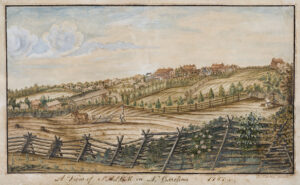
“A View of SALEM in N. Carolina 1787”
This watercolor was produced in Salem, North Carolina in 1787 by painter Ludwig Von Redeken (1757-1797), who is present in the image to the right of the ploughman. Commissioned by the local Moravian congregation twenty years after the town’s foundation, this painting was intended to visually communicate the prosperous development of the Salem settlement to congregational authorities in the Brethren’s traditional governing center of Herrnhurst, Germany. As the Herrnhurst congregation was primarily responsible for financing the initial wave of Moravian settlement across the world during the late 18th century, images such as this one were used as “proof” of a return on the German Brethren’s investment. While this image primarily showcases the community’s economic success to wealthier European Moravians, it also reveals, in not-so-subtle ways, how the community sought to shape its outside perception: a virtuous, Christian city on a hill, above and apart from the world’s overwhelming vice.
Omnipresent within Von Redeken’s watercolor is the communication of Salem’s abundant agrarian wealth. The foreground, which we view as if from outside the nearest farm lot’s fence, is dominated by four vast, rolling, yet neatly organized fields. The borders of each lot are lined with bright green foliage, indicating the God-given fertility of this site and the utility it may offer enterprising farmers. A typically austerely dressed Moravian Brother and a team of horses plow the nearest field, to the left of Ludwig, indicating to the viewer the true source of the community’s wealth and development: the virtuous farmer. For the Moravians, and many other 18th-century Protestant sects, commercial success in agriculture or any other industry was seen not as the result of privileged access to resources or superior business know-how, but as the direct result of an individual’s adherence to Christian virtue. To an 18th-century viewer, this image would have made clear that this is a God-fearing location and, as a result, an economically successful one.
Moreover, the size of the fields implies the community’s egalitarian aspirations. From a somewhat uneven perspective, one can see the rough equality in the size of the fenced plots. Born amid the sectarian chaos of the Thirty Years’ War, the Brethren were ideologically (if not materially) radically anti-hierarchical. Initially only anti-clerical, by the 17th century Moravian theologians sought to boldly critique and deconstruct traditional systems of domination. Unlike contemporary critics, Moravian theologians railed against these systems because they discouraged a Biblically ordained Christian lifestyle. Thus, early Moravian settlements in colonial spaces were organized to grant community members roughly equal access to agricultural land and resources while barring private tenure. Unlike the decadent Old World, the farms here are not sprawling aristocratic concerns worked by bonded peasants and centered on a manor; rather, these are familial and communal concerns, orbiting not around a vertically imposing, military structure of patriarchal force but a horizontally organized commune of the United Brethren.
Further indications of Salem township’s piety appear in the settlement’s conspicuous separation from the outside world. This singular, subtle detail speaks volumes about the community’s tenuous relationship with outsiders and its desire to contain potentially corrupting, vicious influences: the situation of the town’s tavern. Positioned just above (the outsider) Ludwig’s head, the tavern appears distant and separate from the town’s tightly packed architecture to the left. While this layout certainly suggests an attempt by the Moravians to distance themselves from vices like revelry and drunkenness, it also reveals a skeptical view of those traveling into the community. During this period, taverns and inns functioned not only as sites of socialization, but also as firms that offered travelers room and board for a price, much like contemporary hotels and resorts. The frontline site of external intercourse is kept at a distance to maintain foundational communal piety, as only a spiritually homogeneous and socially segregated community could guarantee the saving of souls, according to the Brethren.
The most apparent display of Salem’s communal piety is the settlement’s position: atop a hill, near to heaven. The row of buildings seems to emerge organically from the fields, like leaves from a tree. Literally, the pious labor of the Brethren has raised the Salem township from the earth and upward toward God. Furthermore, the commonly deployed biblical motif of a “city upon a hill” is visibly present, a mobilizing concept used by a variety of Protestant religious sects from the 16th century to the present. This concept describes the long-term objective of many radical Protestant settlement projects during the colonial period: building a virtuously superior community that could serve as a guiding light to salvation in a dark, fallen world. Literally located atop a hill, we view the city as an approaching outsider may have seen it, from below and far away. The scale imbues the otherwise idyllic location with divine grandeur, as the city itself is backlit by subtle white heavenly light. Like a lighthouse in a storm, Salem’s position can guide the traveler’s soul from sin.
In summary, this image communicates a succinct message to the viewer: Salem is prospering because Salem is virtuous. In the brave new world of North Carolina, so painted Ludwig, the hierarchy of Old Europe and its resultant deprivations have been abolished, paving the way for the Millennium of just relations. Of course, these idealistic aspirations worked to obscure a much messier social tapestry on the ground: A community riven with severe inequalities even among its white members, an increasing reliance on slave labor and external markets despite formal prohibitions, presided over by an ever more distant class of congregational authorities. But how did this gulf between theory and praxis emerge? Like everything else, human power relations grow from the ground up, and the innate qualities of that ground shape those relations’ trajectories. The egalitarian regime of land access organized by the Salem Church in the 1770s was unstable from the outset because of the naturally uneven land and soil quality of the North Carolina Piedmont. In microcosm, this community’s fate reflects the outcomes of other egalitarian colonial projects: the hard realities of resource scarcity and individual incentive render equitable distribution a distant horizon and produce new hierarchies.