
Toxic Shoreline, Worried Neighbors: Cancer Concerns and the Aeromarine Landfill in Keyport, New Jersey, 1962 to 2026
by Adam Eliraky
Site Description:
Keyport, New Jersey is a small town on the Raritan Bay that has been residing next to the former Aeromarine landfill for over sixty years. This landfill operated from 1962 until it was decommissioned in 1979, yet it was never fully capped or cleaned up. When the state last tested the site in 2010 it found several toxins leaking out of the landfill and into the bay. In 2026 a local resident began marking the homes of neighbors diagnosed with cancer on a map, and the numbers grew quickly from about 40 cases, with 28 of them on one street, to 370 cases in a preliminary study of the area around the landfill. It is important to note that no official finding has proven that the landfill caused these cancers, but it is clear that residents feel something is wrong and they are demanding answers. My research asks why a site that was closed in 1979 was still not cleaned up almost fifty years later, and who was responsible for that, whether it was the property owners, the state, or the federal government. I also want to look at how the residents themselves became the ones collecting the evidence when the official process was slow to respond, and what this shows about whose evidence gets believed in environmental disputes. This project matters because Keyport shows how a community can be left to deal with a problem that was created long before they ever moved in, and no matter where you stand on the cause of the cancers, it is clear that the people who live there deserve to be heard.
Lorem ipsum dolor sit amet, consectetur adipiscing elit, sed do eiusmod tempor incididunt ut labore et dolore magna aliqua. Ut enim ad minim veniam, quis nostrud exercitation ullamco laboris nisi ut aliquip ex ea commodo consequat. Duis aute irure dolor in reprehenderit in voluptate velit esse cillum dolore eu fugiat nulla pariatur. Excepteur sint occaecat cupidatat non proident, sunt in culpa qui officia deserunt mollit anim id est laborum.
Lorem ipsum dolor sit amet, consectetur adipiscing elit, sed do eiusmod tempor incididunt ut labore et dolore magna aliqua. Ut diam quam nulla porttitor massa id. Elementum facilisis leo vel fringilla est ullamcorper eget nulla. Orci porta non pulvinar neque laoreet suspendisse interdum. Purus semper eget duis at tellus at urna. Diam maecenas ultricies mi eget mauris. Diam ut venenatis tellus in metus vulputate eu. Ullamcorper morbi tincidunt ornare massa eget egestas. Quis eleifend quam adipiscing vitae proin. Consectetur adipiscing elit pellentesque habitant. Cras fermentum odio eu feugiat pretium nibh ipsum consequat nisl. Lectus mauris ultrices eros in cursus turpis massa. Luctus accumsan tortor posuere ac. Porttitor eget dolor morbi non arcu. Maecenas pharetra convallis posuere morbi leo urna molestie. Neque convallis a cras semper auctor neque vitae. In iaculis nunc sed augue. Suspendisse interdum consectetur libero id faucibus. Sit amet porttitor eget dolor.
Felis eget nunc lobortis mattis aliquam faucibus. At elementum eu facilisis sed odio. Eu facilisis sed odio morbi quis commodo odio aenean sed. Habitasse platea dictumst quisque sagittis purus sit amet. Et ultrices neque ornare aenean euismod elementum nisi quis eleifend. Velit dignissim sodales ut eu sem integer. Morbi tempus iaculis urna id volutpat lacus laoreet non curabitur. Aliquam eleifend mi in nulla posuere sollicitudin aliquam. Nunc congue nisi vitae suscipit. Convallis tellus id interdum velit laoreet id. Turpis in eu mi bibendum neque egestas. Magna fermentum iaculis eu non diam phasellus vestibulum. In cursus turpis massa tincidunt dui ut ornare lectus sit.
Non pulvinar neque laoreet suspendisse. Eros donec ac odio tempor orci. Nullam non nisi est sit amet facilisis magna etiam tempor. Platea dictumst vestibulum rhoncus est pellentesque elit ullamcorper. Eleifend donec pretium vulputate sapien nec sagittis aliquam. Proin fermentum leo vel orci porta. Eget dolor morbi non arcu risus quis varius quam quisque. Nec ultrices dui sapien eget mi proin sed. Nisl nisi scelerisque eu ultrices vitae auctor eu augue. Pellentesque pulvinar pellentesque habitant morbi tristique senectus et netus et. Pellentesque habitant morbi tristique senectus et. Pulvinar elementum integer enim neque volutpat ac. Vel orci porta non pulvinar neque. Laoreet sit amet cursus sit amet.
Pharetra massa massa ultricies mi quis hendrerit dolor magna. Mattis nunc sed blandit libero volutpat. Nec ultrices dui sapien eget. Gravida neque convallis a cras semper auctor neque. Aenean et tortor at risus viverra adipiscing at. Quisque non tellus orci ac auctor augue mauris. Ultrices in iaculis nunc sed augue lacus. Quam elementum pulvinar etiam non. Felis bibendum ut tristique et egestas. Sagittis nisl rhoncus mattis rhoncus. Ac ut consequat semper viverra. Volutpat commodo sed egestas egestas fringilla phasellus faucibus scelerisque. Urna condimentum mattis pellentesque id nibh tortor. Erat nam at lectus urna duis convallis convallis. Malesuada fames ac turpis egestas sed tempus urna et pharetra. Pellentesque diam volutpat commodo sed egestas egestas. Interdum velit euismod in pellentesque massa placerat duis ultricies lacus. Est velit egestas dui id. Pellentesque id nibh tortor id aliquet lectus proin nibh. Id nibh tortor id aliquet lectus proin nibh nisl.
Primary Sources:
Lorem ipsum dolor sit amet, consectetur adipiscing elit, sed do eiusmod tempor incididunt ut labore et dolore magna aliqua. Ut diam quam nulla porttitor massa id. Elementum facilisis leo vel fringilla est ullamcorper eget nulla. Orci porta non pulvinar neque laoreet suspendisse interdum. Purus semper eget duis at tellus at urna. Diam maecenas ultricies mi eget mauris. Diam ut venenatis tellus in metus vulputate eu. Ullamcorper morbi tincidunt ornare massa eget egestas. Quis eleifend quam adipiscing vitae proin. Consectetur adipiscing elit pellentesque habitant. Cras fermentum odio eu feugiat pretium nibh ipsum consequat nisl. Lectus mauris ultrices eros in cursus turpis massa. Luctus accumsan tortor posuere ac. Porttitor eget dolor morbi non arcu. Maecenas pharetra convallis posuere morbi leo urna molestie. Neque convallis a cras semper auctor neque vitae. In iaculis nunc sed augue. Suspendisse interdum consectetur libero id faucibus. Sit amet porttitor eget dolor.
Felis eget nunc lobortis mattis aliquam faucibus. At elementum eu facilisis sed odio. Eu facilisis sed odio morbi quis commodo odio aenean sed. Habitasse platea dictumst quisque sagittis purus sit amet. Et ultrices neque ornare aenean euismod elementum nisi quis eleifend. Velit dignissim sodales ut eu sem integer. Morbi tempus iaculis urna id volutpat lacus laoreet non curabitur. Aliquam eleifend mi in nulla posuere sollicitudin aliquam. Nunc congue nisi vitae suscipit. Convallis tellus id interdum velit laoreet id. Turpis in eu mi bibendum neque egestas. Magna fermentum iaculis eu non diam phasellus vestibulum. In cursus turpis massa tincidunt dui ut ornare lectus sit.
Non pulvinar neque laoreet suspendisse. Eros donec ac odio tempor orci. Nullam non nisi est sit amet facilisis magna etiam tempor. Platea dictumst vestibulum rhoncus est pellentesque elit ullamcorper. Eleifend donec pretium vulputate sapien nec sagittis aliquam. Proin fermentum leo vel orci porta. Eget dolor morbi non arcu risus quis varius quam quisque. Nec ultrices dui sapien eget mi proin sed. Nisl nisi scelerisque eu ultrices vitae auctor eu augue. Pellentesque pulvinar pellentesque habitant morbi tristique senectus et netus et. Pellentesque habitant morbi tristique senectus et. Pulvinar elementum integer enim neque volutpat ac. Vel orci porta non pulvinar neque. Laoreet sit amet cursus sit amet.
Pharetra massa massa ultricies mi quis hendrerit dolor magna. Mattis nunc sed blandit libero volutpat. Nec ultrices dui sapien eget. Gravida neque convallis a cras semper auctor neque. Aenean et tortor at risus viverra adipiscing at. Quisque non tellus orci ac auctor augue mauris. Ultrices in iaculis nunc sed augue lacus. Quam elementum pulvinar etiam non. Felis bibendum ut tristique et egestas. Sagittis nisl rhoncus mattis rhoncus. Ac ut consequat semper viverra. Volutpat commodo sed egestas egestas fringilla phasellus faucibus scelerisque. Urna condimentum mattis pellentesque id nibh tortor. Erat nam at lectus urna duis convallis convallis. Malesuada fames ac turpis egestas sed tempus urna et pharetra. Pellentesque diam volutpat commodo sed egestas egestas. Interdum velit euismod in pellentesque massa placerat duis ultricies lacus. Est velit egestas dui id. Pellentesque id nibh tortor id aliquet lectus proin nibh. Id nibh tortor id aliquet lectus proin nibh nisl.
Consequat semper viverra nam libero justo laoreet sit. Ornare massa eget egestas purus viverra accumsan in. Dignissim diam quis enim lobortis scelerisque fermentum dui faucibus in. Curabitur gravida arcu ac tortor dignissim convallis aenean et tortor. Erat nam at lectus urna duis convallis convallis tellus. Risus at ultrices mi tempus imperdiet nulla malesuada pellentesque elit. Turpis egestas maecenas pharetra convallis posuere morbi leo. Nulla facilisi etiam dignissim diam quis enim lobortis. Pellentesque massa placerat duis ultricies. Est ante in nibh mauris cursus. Massa sed elementum tempus egestas sed sed risus. Augue ut lectus arcu bibendum at varius. Neque viverra justo nec ultrices dui sapien eget mi proin. Non diam phasellus vestibulum lorem sed risus ultricies. Venenatis cras sed felis eget velit aliquet sagittis id consectetur. Tristique et egestas quis ipsum suspendisse. Facilisis volutpat est velit egestas dui. Non nisi est sit amet facilisis magna. Scelerisque mauris pellentesque pulvinar pellentesque habitant morbi tristique senectus. Bibendum at varius vel pharetra vel turpis nunc.
Secondary Sources:
Blum, Elizabeth D. Love Canal Revisited: Race, Class, and Gender in Environmental Activism. Lawrence: University Press of Kansas, 2008.
This source is a book that analyzes the Love Canal disaster in Niagara Falls, New York, and looks at how race, class, and gender shaped the way different groups of residents experienced it and fought back.
This book will help me understand Keyport because it shows that a community fighting a contaminated dump is never one single group with one single voice. Blum explains that Love Canal is usually remembered through Lois Gibbs and the homeowners association, but that other residents, such as Black women and middle class allies, also played a major role and were treated differently. For Keyport, this gives me a way to ask who exactly the residents were that began mapping cancer cases, who was listened to by the state, and who was not. It is also a very useful example of a landfill being left behind for a community that had no idea what was under their homes. Using Love Canal as a comparison will help me show what is unique about Keyport and what is part of a larger pattern.
Brown, Phil. Toxic Exposures: Contested Illnesses and the Environmental Health Movement. New York: Columbia University Press, 2007.
This source is a book that explains how ordinary people organize around illnesses they believe are caused by pollution, and how scientists and government agencies often dispute those claims.
This book will be the main tool I use to understand how the Keyport residents gathered their own evidence. Brown writes about what he calls popular epidemiology, which is when community members collect health information themselves instead of waiting for official studies. That is clearly what happened in Keyport, where a resident marked cancer cases on a map and a news organization later commissioned a study when the number of reported cases kept growing. The book also explains why these cases are so hard to prove, which matters because state officials have said that no link between the landfill and the cancers has been confirmed. It will help me avoid claiming that the landfill caused the cancers, while still taking seriously why residents believe it did and why their evidence is questioned.
Fagin, Dan. Toms River: A Story of Science and Salvation. New York: Bantam, 2013.
This source is a book, and winner of the 2014 Pulitzer Prize for General Nonfiction, that tells the history of industrial pollution and a suspected cancer cluster in Toms River, New Jersey.
This is the closest comparison I have to my own site, since it takes place in the same state and deals with the same question of whether pollution is behind a cluster of cancers. Fagin follows chemical companies, including Ciba-Geigy, that dumped waste in Toms River from 1952 through the 1980s, and then follows the investigations of the cancer cluster that came afterward. This covers a time period that overlaps with the years that the Aeromarine landfill was operating, so it will help me understand what waste disposal looked like in New Jersey back then and how little regulation there was. It will also show me how long investigations like this can take, which helps explain why Keyport residents are still waiting for answers decades after their landfill was shut down.
Hurley, Andrew. Environmental Inequalities: Class, Race, and Industrial Pollution in Gary, Indiana, 1945-1980. Chapel Hill: University of North Carolina Press, 1995.
This source is a book that analyzes how industry, race, and class shaped pollution in the steel city of Gary, Indiana, from the end of World War II through 1980.
This book will help me understand the larger postwar world that the Aeromarine landfill came out of, since it covers almost the exact same years that the landfill was operating, 1962 to 1979. Hurley argues that industry and wealthier residents were able to protect their own interests, which left poorer residents in declining neighborhoods exposed to hazardous pollution. I want to see if a similar pattern can be found in Keyport, where a waterfront industrial site was allowed to operate next to homes. It also helps me think about how a town’s reliance on local industry can make people slower to challenge it. Even though Gary and Keyport are very different places, it is clear that Hurley’s focus on class will give me a stronger way to analyze who bore the risk in Keyport.
Melosi, Martin V. The Sanitary City: Environmental Services in Urban America from Colonial Times to the Present. Abridged ed. Pittsburgh: University of Pittsburgh Press, 2008.
This source is a book that traces the history of water supply, sewage, and solid waste disposal in American cities across three eras, including the postwar period from 1945 to the present.
This book will give me the background on how Americans dealt with their garbage, which is the basic history behind the Aeromarine landfill. Melosi explains how solid waste disposal developed over time, so it can help me understand why a landfill like Keyport’s would have been seen as a normal and acceptable way to get rid of waste in the 1960s. This matters for my main question, which asks why the site was left uncleaned for so long. If I can show that landfills were once thought of as a simple solution, then it makes sense that the dangers were not taken seriously until much later. It also adds a broader time frame to my research, so that I am not just looking at the cancer cases of 2026 but at the long history of how waste became a problem that communities like Keyport have to live with.
Image Analysis:
Lorem ipsum dolor sit amet, consectetur adipiscing elit, sed do eiusmod tempor incididunt ut labore et dolore magna aliqua. Ut diam quam nulla porttitor massa id. Elementum facilisis leo vel fringilla est ullamcorper eget nulla. Orci porta non pulvinar neque laoreet suspendisse interdum. Purus semper eget duis at tellus at urna. Diam maecenas ultricies mi eget mauris. Diam ut venenatis tellus in metus vulputate eu. Ullamcorper morbi tincidunt ornare massa eget egestas. Quis eleifend quam adipiscing vitae proin. Consectetur adipiscing elit pellentesque habitant. Cras fermentum odio eu feugiat pretium nibh ipsum consequat nisl. Lectus mauris ultrices eros in cursus turpis massa. Luctus accumsan tortor posuere ac. Porttitor eget dolor morbi non arcu. Maecenas pharetra convallis posuere morbi leo urna molestie. Neque convallis a cras semper auctor neque vitae. In iaculis nunc sed augue. Suspendisse interdum consectetur libero id faucibus. Sit amet porttitor eget dolor.
Felis eget nunc lobortis mattis aliquam faucibus. At elementum eu facilisis sed odio. Eu facilisis sed odio morbi quis commodo odio aenean sed. Habitasse platea dictumst quisque sagittis purus sit amet. Et ultrices neque ornare aenean euismod elementum nisi quis eleifend. Velit dignissim sodales ut eu sem integer. Morbi tempus iaculis urna id volutpat lacus laoreet non curabitur. Aliquam eleifend mi in nulla posuere sollicitudin aliquam. Nunc congue nisi vitae suscipit. Convallis tellus id interdum velit laoreet id. Turpis in eu mi bibendum neque egestas. Magna fermentum iaculis eu non diam phasellus vestibulum. In cursus turpis massa tincidunt dui ut ornare lectus sit.
Non pulvinar neque laoreet suspendisse. Eros donec ac odio tempor orci. Nullam non nisi est sit amet facilisis magna etiam tempor. Platea dictumst vestibulum rhoncus est pellentesque elit ullamcorper. Eleifend donec pretium vulputate sapien nec sagittis aliquam. Proin fermentum leo vel orci porta. Eget dolor morbi non arcu risus quis varius quam quisque. Nec ultrices dui sapien eget mi proin sed. Nisl nisi scelerisque eu ultrices vitae auctor eu augue. Pellentesque pulvinar pellentesque habitant morbi tristique senectus et netus et. Pellentesque habitant morbi tristique senectus et. Pulvinar elementum integer enim neque volutpat ac. Vel orci porta non pulvinar neque. Laoreet sit amet cursus sit amet.
Pharetra massa massa ultricies mi quis hendrerit dolor magna. Mattis nunc sed blandit libero volutpat. Nec ultrices dui sapien eget. Gravida neque convallis a cras semper auctor neque. Aenean et tortor at risus viverra adipiscing at. Quisque non tellus orci ac auctor augue mauris. Ultrices in iaculis nunc sed augue lacus. Quam elementum pulvinar etiam non. Felis bibendum ut tristique et egestas. Sagittis nisl rhoncus mattis rhoncus. Ac ut consequat semper viverra. Volutpat commodo sed egestas egestas fringilla phasellus faucibus scelerisque. Urna condimentum mattis pellentesque id nibh tortor. Erat nam at lectus urna duis convallis convallis. Malesuada fames ac turpis egestas sed tempus urna et pharetra. Pellentesque diam volutpat commodo sed egestas egestas. Interdum velit euismod in pellentesque massa placerat duis ultricies lacus. Est velit egestas dui id. Pellentesque id nibh tortor id aliquet lectus proin nibh. Id nibh tortor id aliquet lectus proin nibh nisl.
Consequat semper viverra nam libero justo laoreet sit. Ornare massa eget egestas purus viverra accumsan in. Dignissim diam quis enim lobortis scelerisque fermentum dui faucibus in. Curabitur gravida arcu ac tortor dignissim convallis aenean et tortor. Erat nam at lectus urna duis convallis convallis tellus. Risus at ultrices mi tempus imperdiet nulla malesuada pellentesque elit. Turpis egestas maecenas pharetra convallis posuere morbi leo. Nulla facilisi etiam dignissim diam quis enim lobortis. Pellentesque massa placerat duis ultricies. Est ante in nibh mauris cursus. Massa sed elementum tempus egestas sed sed risus. Augue ut lectus arcu bibendum at varius. Neque viverra justo nec ultrices dui sapien eget mi proin. Non diam phasellus vestibulum lorem sed risus ultricies. Venenatis cras sed felis eget velit aliquet sagittis id consectetur. Tristique et egestas quis ipsum suspendisse. Facilisis volutpat est velit egestas dui. Non nisi est sit amet facilisis magna. Scelerisque mauris pellentesque pulvinar pellentesque habitant morbi tristique senectus. Bibendum at varius vel pharetra vel turpis nunc.
Data Analysis:
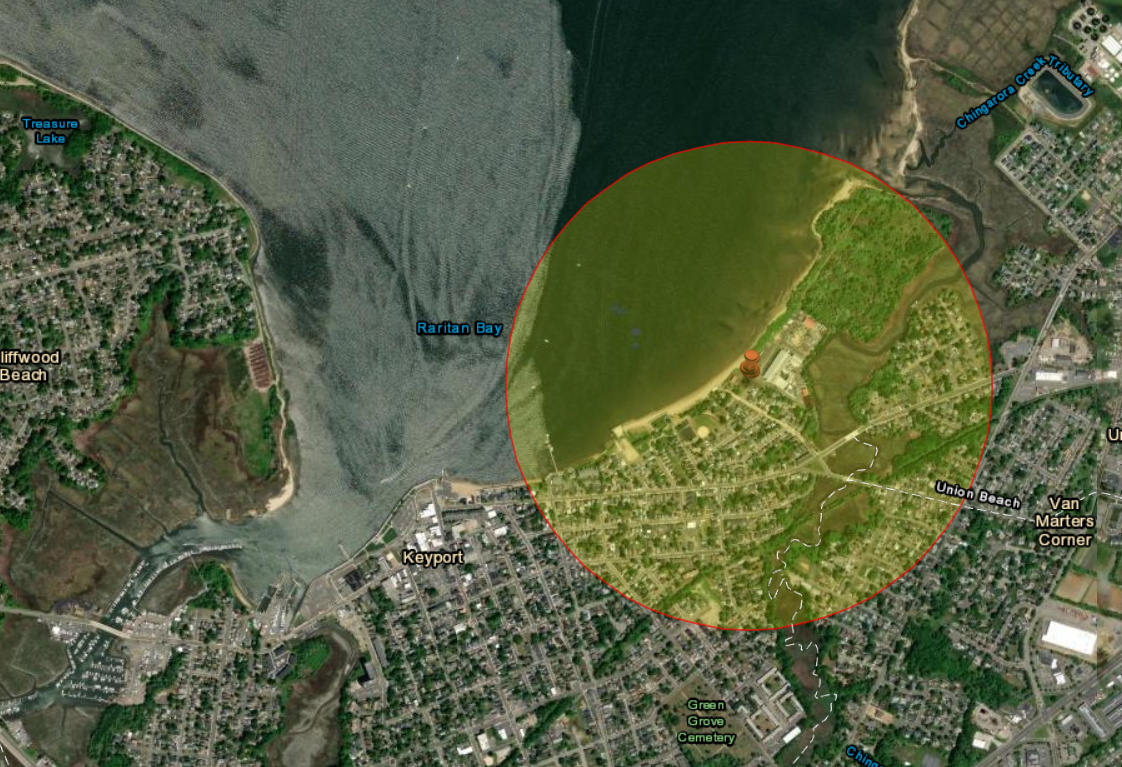
EJScreen circular buffer with a 0.44-mile radius (0.61 square miles, 1,897 residents) centered on the Aeromarine landfill, Keyport, New Jersey.
Introduction
My site is the former Aeromarine landfill in Keyport, New Jersey, a dump on the Raritan Bay that took in waste from 1962 to 1979 and was never fully capped or cleaned up. Residents have mapped hundreds of cancer cases around the landfill, while the state says it has found no sign that contamination is reaching nearby neighborhoods. To study the people who live closest to the site, I used a circular buffer with a 0.44 mile radius centered on the landfill, which covers 0.61 square miles and 1,897 residents. I chose this size because residents say the cancer cluster covers about 0.6 square miles, and I wanted the data to match the area they are worried about instead of averaging their neighborhood in with a much larger one. I used a circle because contamination from a landfill can move through soil, groundwater, stormwater, and air in any direction. The question I want to answer is who lives inside the area residents have marked and what kinds of pollution they live with. My argument is that these residents do not fit the usual picture of an environmental justice community, yet they still live with old burdens from waste and housing that EJScreen has trouble measuring.
Environmental Data Analysis
The “Pollution and Sources” data shows that the biggest problems near the landfill come from old housing, nearby waste sites, and the drinking water system, while air pollution ranks fairly low.
| Indicator | Value in buffer | National percentile | State percentile |
|---|---|---|---|
| Superfund Proximity | 0.72 sites/km | 88 | 42 |
| Drinking Water Non-Compliance | 2.0 | 87 | 77 |
| Lead Paint (pre-1960 housing) | 58% | 79 | 66 |
| Diesel Particulate Matter | 0.241 µg/m³ | 74 | 47 |
| Underground Storage Tanks | 3.7 | 74 | 38 |
| Toxic Releases to Air | 540 | 48 | 26 |
| Traffic Proximity | 640,000 | 44 | 29 |
| Particulate Matter (PM 2.5) | 7.36 µg/m³ | 26 | 25 |