Environmental Justice in Bayonne: Oil Spills in the 1970s
by Luis Vieira
Site Description:
The 1977 court case “State, Dept. of Envtl. Protection v. Exxon Corp. and ICI America, Inc.”
was the starting point of environmental justice for Bayonne, NJ, a community that has suffered
with several oil leaks over decades as a result of refinery activity. Several related court cases
followed, resulting in remediation efforts by Exxon in the community. However, it was not until
2015 that a major settlement was reached with the state. During the years following the initial
pollution incidents, many white blue-collar workers left the city. Several decades later, Hispanic and Middle Eastern immigrant communities contributed to Bayonne’s demographic recovery.
The historical questions guiding this project concern the actual impact of the oil leaks on the
local community are the following: How did pollution affect the quality of life in the town? Did
pollution become a factor in people leaving the city? What were the challenges residents faced
in protesting against the pollution? Did divisions arise in the community? Why? How the
eventual settlement was negotiated and perceived by residents? In addition, the project will
examine the company’s perspective on the refinery, its response to the reported leaks, and its
relationship with the affected community. Bayonne’s estimated population in 1977 was nearly
70,000 and reduced by the 5,000 inhabitants in the years that followed. By examining these
developments, the research seeks to understand how industrial pollution, the community
engagement, the departure of established residents, and the later arrival of immigrant
populations influenced Bayonne’s quality of life, community relations, and the environmental
justice achievements.
Lorem ipsum dolor sit amet, consectetur adipiscing elit, sed do eiusmod tempor incididunt ut labore et dolore magna aliqua. Ut enim ad minim veniam, quis nostrud exercitation ullamco laboris nisi ut aliquip ex ea commodo consequat. Duis aute irure dolor in reprehenderit in voluptate velit esse cillum dolore eu fugiat nulla pariatur. Excepteur sint occaecat cupidatat non proident, sunt in culpa qui officia deserunt mollit anim id est laborum.
Lorem ipsum dolor sit amet, consectetur adipiscing elit, sed do eiusmod tempor incididunt ut labore et dolore magna aliqua. Ut diam quam nulla porttitor massa id. Elementum facilisis leo vel fringilla est ullamcorper eget nulla. Orci porta non pulvinar neque laoreet suspendisse interdum. Purus semper eget duis at tellus at urna. Diam maecenas ultricies mi eget mauris. Diam ut venenatis tellus in metus vulputate eu. Ullamcorper morbi tincidunt ornare massa eget egestas. Quis eleifend quam adipiscing vitae proin. Consectetur adipiscing elit pellentesque habitant. Cras fermentum odio eu feugiat pretium nibh ipsum consequat nisl. Lectus mauris ultrices eros in cursus turpis massa. Luctus accumsan tortor posuere ac. Porttitor eget dolor morbi non arcu. Maecenas pharetra convallis posuere morbi leo urna molestie. Neque convallis a cras semper auctor neque vitae. In iaculis nunc sed augue. Suspendisse interdum consectetur libero id faucibus. Sit amet porttitor eget dolor.
Felis eget nunc lobortis mattis aliquam faucibus. At elementum eu facilisis sed odio. Eu facilisis sed odio morbi quis commodo odio aenean sed. Habitasse platea dictumst quisque sagittis purus sit amet. Et ultrices neque ornare aenean euismod elementum nisi quis eleifend. Velit dignissim sodales ut eu sem integer. Morbi tempus iaculis urna id volutpat lacus laoreet non curabitur. Aliquam eleifend mi in nulla posuere sollicitudin aliquam. Nunc congue nisi vitae suscipit. Convallis tellus id interdum velit laoreet id. Turpis in eu mi bibendum neque egestas. Magna fermentum iaculis eu non diam phasellus vestibulum. In cursus turpis massa tincidunt dui ut ornare lectus sit.
Non pulvinar neque laoreet suspendisse. Eros donec ac odio tempor orci. Nullam non nisi est sit amet facilisis magna etiam tempor. Platea dictumst vestibulum rhoncus est pellentesque elit ullamcorper. Eleifend donec pretium vulputate sapien nec sagittis aliquam. Proin fermentum leo vel orci porta. Eget dolor morbi non arcu risus quis varius quam quisque. Nec ultrices dui sapien eget mi proin sed. Nisl nisi scelerisque eu ultrices vitae auctor eu augue. Pellentesque pulvinar pellentesque habitant morbi tristique senectus et netus et. Pellentesque habitant morbi tristique senectus et. Pulvinar elementum integer enim neque volutpat ac. Vel orci porta non pulvinar neque. Laoreet sit amet cursus sit amet.
Pharetra massa massa ultricies mi quis hendrerit dolor magna. Mattis nunc sed blandit libero volutpat. Nec ultrices dui sapien eget. Gravida neque convallis a cras semper auctor neque. Aenean et tortor at risus viverra adipiscing at. Quisque non tellus orci ac auctor augue mauris. Ultrices in iaculis nunc sed augue lacus. Quam elementum pulvinar etiam non. Felis bibendum ut tristique et egestas. Sagittis nisl rhoncus mattis rhoncus. Ac ut consequat semper viverra. Volutpat commodo sed egestas egestas fringilla phasellus faucibus scelerisque. Urna condimentum mattis pellentesque id nibh tortor. Erat nam at lectus urna duis convallis convallis. Malesuada fames ac turpis egestas sed tempus urna et pharetra. Pellentesque diam volutpat commodo sed egestas egestas. Interdum velit euismod in pellentesque massa placerat duis ultricies lacus. Est velit egestas dui id. Pellentesque id nibh tortor id aliquet lectus proin nibh. Id nibh tortor id aliquet lectus proin nibh nisl.
Primary Sources:
The 1977 court decision is the groundbreak for environmental justice concerning oil spills in Bayonne. The state of New Jersey’s Environmental Protection Agency sued Exxon Corporation and ICI America over multiple crude oil spills over the Constable Hook neighborhood that occurred throughout the 1970s. In the ruling, judge John Kentz asserted in June 15, 1977 that ICI America was not liable for pollution, while Exxon agreed to remedy the pollution on its own property. This case provides a legal starting point for examining Exxon’s pollution, the state’s response, and the challenges of holding industrial companies accountable for environmental harm in Bayonne. The NJ DEP filed the lawsuit in 1974.
In State, Department of Environmental Protection v. Exxon Corp. and ICI America, Inc., 151 N.J. Super. 464 (1977), Judge Kentz states “During the course of their refining, storing and transfer operations, Exxon spilled, permitted to leak and intentionally discharged massive quantities of oil on and into the ground of the Exxon property, including that portion which is now the ICI property.”
The court further stated on page 469: “With regard to defendant Exxon, a stipulation of dismissal was previously filed with this court which requires that Exxon remedy the petroleum pollution problems which exist on its property at the Constable Hook section of Bayonne.” Later, on pages 484–485, Judge Kentz observed: “Exxon, which admittedly was the owner of the property and which was responsible for creating the pollution, is available and is a party to this action. The State could have sought to have Exxon directed to remedy the condition with the cooperation of ICI.”
The groundbreaking aspect is suggested because there was no prior decision related to these oil spills in Bayonne, New Jersey. But after the 1977 decision, several other decisions and cases followed. It also starts the formal state response to the pollution started by Exxon’s pollution.
- State, Department of Environmental Protection v. Exxon Corporation and ICI America, Inc., 151 N.J. Super. 464, 376 A.2d 1339 (N.J. Super. Ct. Ch. Div. 1977)
The 1977 court decision is the groundbreak for environmental justice concerning oil spills in Bayonne. The state of New Jersey’s Environmental Protection Agency sued Exxon Corporation and ICI America over multiple crude oil spills over the Constable Hook neighborhood that occurred throughout the 1970s. In the ruling, judge John Kentz asserted in June 15, 1977 that ICI America was not liable for pollution, while Exxon agreed to remedy the pollution on its own property. This case provides a legal starting point for examining Exxon’s pollution, the state’s response, and the challenges of holding industrial companies accountable for environmental harm in Bayonne. The NJ DEP filed the lawsuit in 1974.
2. New Jersey Department of Environmental Protection. “Exxon Agrees to Oil Cleanup Program at Constable Hook Location (Bayonne).” July/August 1976, 16D.
The New Jersey Department of Environmental Protection bulletin explains the department had filed suit against Exxon and ICI in 1974 to stop oil seepage into Lower New York Bay and require cleanup. Exxon agreed to remedy pollution on its own property, and the state approved a groundwater collection plan. This provides background information prior to the court decision.
3. “Bayonne Leads Oil Spills.” The Jersey Journal, March 18, 1977, p. 3.
The 1977 article in the Jersey Journal provides a broader context of the significance of oil spills affecting Bayonne in the year 1977.
4. 8 State Oil Spills in Three Months; Coast Guard Survey Lists.” The New York Times, August 8, 1973.
The August 8, 1973 New York Times article provides information on several oil spills in the US Northeast prior to the 1974 lawsuit. This helps situate the Bayonne spills in a broader context of this type of pollution.
5. Exxon Corporation. Exxon and the Environment. New York: Exxon Corporation, 1975.
Exxon Corporation has published a 1975 document that is a guidance for their environment policies and practices. It will help illustrate their own view of environmental issues.
6. Revesz, Dennis. “Coast Guard Says Oil Spill Off S.I. Exceeds 200,000 Gallons.” The New York Times, January 4, 1990.
This article reports the growing estimates of heating oil released from an Exxon underwater pipeline into the Arthur Kill on January 3, 1990. The spill became the source of new lawsuits in the years thereafter.
7. New Jersey Department of Environmental Protection and Exxon Corporation. Administrative Consent Order: Bayonne Plant, Bayonne, New Jersey. December 19, 1991.
An agreement between the New Jersey Department of Environmental Protection (NJDEP) and Exxon Corporation was signed on December 19, 1991. Exxon agreed to pay $1.35 million for the Bayonne site, while denying that it had violated applicable laws or regulations and was required to investigate the nature and extent of hazardous-substance and pollutant contamination, by removing hazardous substances under NJDEP supervision. The order was important for the 2007 court decision.
8. N.J. Department of Environmental Protection v. Exxon Mobil Corp., 393 N.J. Super. 388, 923 A.2d 345 (App. Div. 2007)
Based on the 1991 consent orders for the Bayonne and Bayway facilities, the court opinion of 2007 reversed the lower court’s dismissal of New Jersey’s claim for damages for the loss of use of natural resources caused by ExxonMobil’s contamination. It held that such damages could be recovered under the New Jersey Spill Compensation and Control Act. This is a milestone to be analyzed in the context of pollution and environmental justice in Bayonne.
9. New Jersey Legislature, General Assembly, Judiciary Committee. Committee Meeting Regarding the Proposed $225 Million Settlement Agreement Between the New Jersey Attorney General’s Office and Exxon Mobil Corporation. March 19, 2015. Trenton, NJ: Office of Legislative Services, Public Information Office.
These sources establish the authority of the 2015 NJ assembly committee to review the Exxon settlement and document its hearings. This is where a broader review of the settlement process starts with the participation of the New Jersey community.
10. New Jersey Legislature, General Assembly, Judiciary Committee. Committee Meeting Regarding the Proposed $225 Million Settlement Agreement Between the Attorney General and ExxonMobil for Environmental Damage Caused by Refinery Operations in Bayonne and Linden. June 3, 2015. Trenton, NJ: Office of Legislative Services, Public Information Office.
The transcript documents the committee’s public hearing in Bayonne, where residents and other witnesses commented on the proposed $225 million settlement for the state of New Jersey, in addition to Exxon’s commitment to pay for cleanup of the contaminated sites.
Secondary Sources:
- Mintz, Joel A. Enforcement at the EPA: High Stakes and Hard Choices. Austin: University of Texas Press, 2012.
Joel Mintz’ Enforcement at the EPA: High Stakes and Hard Choices will help understand the EPA”s scope of investigation on Bayonne’s oil spills and perhaps assess the agency performance in each case. It may also provide a framework for evaluating the challenges federal regulators face when enforcing environmental laws.
- Perrow, Charles. Normal Accidents: Living with High-Risk Technologies. New York: Basic Books, 1984.
Normal Accidents: Living with High-Risk Technologies may provide information on the preventability of oil spill in refiners and port terminals. His analysis of how failures can emerge from the interaction of technological and organizational factors may provide a useful framework for examining the circumstances surrounding the spills.
- Stradling, David. Smokestacks and Progressives: Environmentalists, Engineers, and Air Quality in America, 1881–1951. Baltimore: Johns Hopkins University Press, 1999.
This book will provide a glance on the environmental justice movement in the United States and may help ask the right questions on the community involvement in Bayonne and contextualize it.
- Sugrue, Thomas J. The Origins of the Urban Crisis: Race and Inequality in Postwar Detroit. Princeton, NJ: Princeton University Press, 1996.
Thomas Sugrue’s may provide analysis on how some groups became more affected than others in terms of pollution in the United States. The book has a specific on urban change affecting employment and housing.
- Westermeyer, William. “Oil Spill Response Capabilities in the United States.” Environmental Science & Technology 25, no. 2 (1991): 196–200.
https://doi.org/10.1021/es00014a607 .
This article highlights the systemic shortcomings in US federal response following the Exxon Valdez oil spill, showing the strengths and limitations of capabilities.
- Burger, Joanna, ed. Oil Spills. Rutgers University Press, 1997.
Joanna Burger OIl Spills analyzes the effects of different oil spills from diverse stand points: sociological, economical, legal, and, of course, environmental. She is a biologist.
- Burger, Joanna, ed. Before and After an Oil Spill: The Arthur Kill. New Brunswick, NJ: Rutgers University Press, 1994.
This is specific about the January 1990 leak where the Exxon Bayway Pipeline spilled heating oil into the Arthur Kill strait, affecting Bayonne. The impact analysis is focused on wildlife, habit, and people.
- McNeill, J. R. Something New Under the Sun: An Environmental History of the Twentieth-Century World. New York: W. W. Norton, 2000.
This book is a broader overview of the environmental history of pollution in the 20th century. It covers aspects such as energy consumption, technological development, and environmental change.
- Pratt, Joseph A., with William E. Hale. Exxon: Transforming Energy, 1973–2005. Austin: Dolph Briscoe Center for American History, University of Texas at Austin, 2013.
This book is an authorized history of Exxon. It will help understand more about the company from their own point of view. The time period is important, since it coincides with the period we are studying in Bayonne. It brings light to Exoon’s policies, culture, and crisis response.
- Sampson, Anthony. The Seven Sisters: The Great Oil Companies and the World They Shaped. New York: Viking Press, 1975.
Image Analysis:
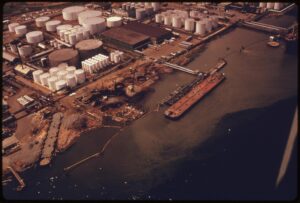
Industrial contamination of the Arthur Kill, Bayonne, New Jersey, June 1974. Photograph by Hope Alexander, documenting industrial pollution along the Arthur Kill waterfront as part of the U.S. Environmental Protection Agency’s DOCUMERICA photographic project (1972–1977).
Source: U.S. Environmental Protection Agency / National Archives and Records Administration, DOCUMERICA, ARC Identifier 555788.
In June 1974, photographer Hope Alexander documented industrial contamination along the Arthur Kill waterfront in Bayonne, New Jersey, as part of the U.S. Environmental Protection Agency’s DOCUMERICA project. The photograph captures an industrial landscape at a time when the environmental consequences of decades of heavy industrial activity along the waterfront were. This is the evidence of the damage generated by oil spills throughout the 1970s.
The significance of this photograph extends beyond an industrial waterfront. It provides a visual record of the environmental conditions that followed decades of petroleum-related industrial activity along the Arthur Kill. By the early 1970s, the consequences of this activity were also being documented through government inspections. In November 1973, the New Jersey Department of Environmental Protection recorded pools of oily water, oil-soaked ground, petroleum flowing through drainage ditches, and oil entering tidal waters in the Constable Hook area. These inspection findings provide supporting evidence that oil pollution was not only an isolated incident, but an ongoing environmental problem affecting the area and surroundings.
The photograph also captures a moment immediately preceding a legal response to this contamination. In September 1974, New Jersey initiated filed a lawsuit against Exxon Corporation and ICI America concerning crude oil seepage from industrial properties at Constable Hook into Lower New York Bay. This becomes part of a broader historical record showing how industrial crude oil pollution affected Bayonne’s waterfront and led to increasing governmental scrutiny and intervention during the 1970s.
The environmental damage documented during this period eventually prompted legal action by the State of New Jersey and culminated in a 1977 agreement requiring Exxon to remediate petroleum pollution on its Constable Hook property. What the working-class neighborhood in Bayonne, New Jersey, has experienced is a microscope of a greater phenomenon in post-war America, where environmental costs affected disproportionately blue-collar communities.