Is Your Baby Drinking Metal?: The Effect of Lead being in the Water System of Newark, NJ on Maternal and Fetal Health from 2017-2021.
by Avelinn Kraft
Site Description:
The Newark water system from 2017-2021 dealt with a major problem involving lead exposure and poisoning. It affected all the wards of Newark, with the central ward being a large focal point of this issue. The issue of unreplaced, old pipes, from which lead was corroding into the water over the years, is where these issues began and all the other problems followed after. Lead poisoning has very serious clinical issues and those who are easily susceptible to these issues are pregnant women and children. Some of these health hazards are such as developmental delays in children, higher risk of miscarriage in pregnant women, and behavioral changes. My research into this is going to mainly focus on the questions, how has lead contamination within the Newark water supply, from 2017-2021, had a lasting impact on maternal and fetal health. How did these women fight back against the lead exposure to get justice for themselves and their children? I want to look further into how badly have the women and children of Newark been affected by lead, and what has been done to amend the damage that has already been done, while also stopping any other damage from occurring. As I dive into this, I should hope to showcase what this did for not only the environmental movement, but also the movement(s) towards further equality regarding reproductive rights.
Lorem ipsum dolor sit amet, consectetur adipiscing elit, sed do eiusmod tempor incididunt ut labore et dolore magna aliqua. Ut enim ad minim veniam, quis nostrud exercitation ullamco laboris nisi ut aliquip ex ea commodo consequat. Duis aute irure dolor in reprehenderit in voluptate velit esse cillum dolore eu fugiat nulla pariatur. Excepteur sint occaecat cupidatat non proident, sunt in culpa qui officia deserunt mollit anim id est laborum.
Lorem ipsum dolor sit amet, consectetur adipiscing elit, sed do eiusmod tempor incididunt ut labore et dolore magna aliqua. Ut diam quam nulla porttitor massa id. Elementum facilisis leo vel fringilla est ullamcorper eget nulla. Orci porta non pulvinar neque laoreet suspendisse interdum. Purus semper eget duis at tellus at urna. Diam maecenas ultricies mi eget mauris. Diam ut venenatis tellus in metus vulputate eu. Ullamcorper morbi tincidunt ornare massa eget egestas. Quis eleifend quam adipiscing vitae proin. Consectetur adipiscing elit pellentesque habitant. Cras fermentum odio eu feugiat pretium nibh ipsum consequat nisl. Lectus mauris ultrices eros in cursus turpis massa. Luctus accumsan tortor posuere ac. Porttitor eget dolor morbi non arcu. Maecenas pharetra convallis posuere morbi leo urna molestie. Neque convallis a cras semper auctor neque vitae. In iaculis nunc sed augue. Suspendisse interdum consectetur libero id faucibus. Sit amet porttitor eget dolor.
Felis eget nunc lobortis mattis aliquam faucibus. At elementum eu facilisis sed odio. Eu facilisis sed odio morbi quis commodo odio aenean sed. Habitasse platea dictumst quisque sagittis purus sit amet. Et ultrices neque ornare aenean euismod elementum nisi quis eleifend. Velit dignissim sodales ut eu sem integer. Morbi tempus iaculis urna id volutpat lacus laoreet non curabitur. Aliquam eleifend mi in nulla posuere sollicitudin aliquam. Nunc congue nisi vitae suscipit. Convallis tellus id interdum velit laoreet id. Turpis in eu mi bibendum neque egestas. Magna fermentum iaculis eu non diam phasellus vestibulum. In cursus turpis massa tincidunt dui ut ornare lectus sit.
Non pulvinar neque laoreet suspendisse. Eros donec ac odio tempor orci. Nullam non nisi est sit amet facilisis magna etiam tempor. Platea dictumst vestibulum rhoncus est pellentesque elit ullamcorper. Eleifend donec pretium vulputate sapien nec sagittis aliquam. Proin fermentum leo vel orci porta. Eget dolor morbi non arcu risus quis varius quam quisque. Nec ultrices dui sapien eget mi proin sed. Nisl nisi scelerisque eu ultrices vitae auctor eu augue. Pellentesque pulvinar pellentesque habitant morbi tristique senectus et netus et. Pellentesque habitant morbi tristique senectus et. Pulvinar elementum integer enim neque volutpat ac. Vel orci porta non pulvinar neque. Laoreet sit amet cursus sit amet.
Pharetra massa massa ultricies mi quis hendrerit dolor magna. Mattis nunc sed blandit libero volutpat. Nec ultrices dui sapien eget. Gravida neque convallis a cras semper auctor neque. Aenean et tortor at risus viverra adipiscing at. Quisque non tellus orci ac auctor augue mauris. Ultrices in iaculis nunc sed augue lacus. Quam elementum pulvinar etiam non. Felis bibendum ut tristique et egestas. Sagittis nisl rhoncus mattis rhoncus. Ac ut consequat semper viverra. Volutpat commodo sed egestas egestas fringilla phasellus faucibus scelerisque. Urna condimentum mattis pellentesque id nibh tortor. Erat nam at lectus urna duis convallis convallis. Malesuada fames ac turpis egestas sed tempus urna et pharetra. Pellentesque diam volutpat commodo sed egestas egestas. Interdum velit euismod in pellentesque massa placerat duis ultricies lacus. Est velit egestas dui id. Pellentesque id nibh tortor id aliquet lectus proin nibh. Id nibh tortor id aliquet lectus proin nibh nisl.
Primary Sources:
Bates, Josiah. “Newark Officials Providing Bottled Water to 15,000 Homes Over Lead Contamination Concerns. Here’s What You Need to Know About the City’s Water Crisis.” TIME, August 16, 2019. https://time.com/5653115/newark-water-crisis/.
Location: Website for TIME Magazine.
Description: This article was published in 2019 and this was during a time when the water crisis was dealing with the consequences of the uptick of lead being found in the water in 2018. As we can also see, there’s an image at the top of the article, which I believe is very important to include, and it shows piles of packaged water bottles in the Newark Health Department. This can help with my research because it gives the baseline information that I need for the situation, but it also gives me insight to what the people were saying and how they felt about lead being found in their water. Getting the insight from how the people felt is incredibly important to know, so this article having quotes from residents assists in giving me the information I’m searching for.
City of Newark, NJ – City Hall. “City – NEWARK’S WATER IS ABSOLUTELY SAFE TO DRINK… | Facebook.” Social Media. Facebook, April 26, 2018. https://www.facebook.com/photo/?fbid=862909017249219&set=a.171394608469128.
Location: Social Media site; Facebook.
Description: The time period that I’m basing this research on is 2017 to 2021, and because it’s so current that means that social media was very prevalent in this situation. This was a Facebook post that was made April 26, 2018 by Newark City Hall. The replies to the post are very interesting to see because so many people have questions and concerns about their water being contaminated by the piping that the city hadn’t fixed. I think this is another source that’s very important to giving me the perspectives of the residents who are directly involved and affected by this issue. Similar to the TIME Magazine article, this post gives me direct quotes from people who have a problem that isn’t being fixed, or even truly seen.
Housing and Community Development Network of New Jersey. “Lead Exposure.” HCDNNJ. https://www.hcdnnj.org/leadexposure.
Location: Website for the HCDNNJ.
Description: This source can help in my research because its information comes directly from a network involved with Newark. There isn’t a specific date that this was posted, but it can be assumed that it was posted sometime in 2021 because of some of the information that was given in the article. This article gives me a lot of information during all the years I want to focus on and it explains a lot of details about lead and what this can do to children. This article is different from the other ones I’m looking for because I want to get the actual science and numbers that I should be looking for, as well as the clinical effects that this exposure has.
Jennings, Debra. “Lead poisoning effects on Newark children’s education.” SPAN Parent Advocacy Network, November 11, 2019. https://www.facebook.com/groups/SPAN.NJ/posts/10156412621316020/.
Location: Social Media site; Facebook.
Description: This is another social media post, very common for the time as mentioned, but this time it’s made in a Facebook group that is made by people who aren’t involved with the city hall or the Newark city government, but it’s just residents who are concerned. More specifically, these people are parents and the group is a parent advocacy group. Since my topic focuses on how the water crisis affected maternal health and the health of children I figured that this group would help in providing insight directly from parents who are worried about their children. This was posted in November 2019, so this also provides a lot of context about how people felt about what the city was, or wasn’t, doing to combat this problem.
Lead-Free Drinking Water for All Act of 2021, S. 2272, 42 (2021). https://www.congress.gov/bill/117th-congress/senate-bill/2272/text.
Location: The website for Congress.
Description: This is a government document that details the Lead-Free Drinking Water for All Act of 2021. This was introduced to the U.S. Senate on June 24, 2021 and it was an act to increase the funding for projects that assist in reducing the amount of lead in drinking water. There was a lot of government involvement in the issues of lead being in the water, primarily because of Flint, Michigan, and then Newark. Including a government bill can help produce information about what the government did to help lessen the amount of lead within water.
Primary source analysis:
“City – NEWARK’S WATER IS ABSOLUTELY SAFE TO DRINK… | Facebook.”
This source is a social media post from April 2018 made by the City of Newark, NJ – City Hall regarding the concerns people have had about the safety of the drinking water. In the post, the poster has made it clear that the water is following the federal and state regulations and that the water is not contaminated by lead. The remainder of this post continues to express how the worries of the residents aren’t needed because the water is completely safe. Looking away from the actual content of the post itself, another important section is the comment section. This consists of what the people actually have to say and we can see these residents don’t agree with the statements coming from the city hall. This source suggests that the city of Newark did a lot of work in attempting to cover up the amount of lead in the water, but clearly this didn’t work out in their favor as we can see in the comments of this posting.
In the body of the post the language alone that the city hall uses makes it very obvious that they’re pushing people to believe what they’re telling them. In the first paragraph, the first sentence uses the language “… absolutely and outrageously false statements…,” which is arguably very strong wording when talking about statements that have been made about Newark’s water system having lead in it. The language in a statement can tell a lot about how someone feels about a certain topic. Similar to how body language can tell a lot about a person, the way something is worded can change the tone of what’s being told. Many of the Facebook users who commented on this don’t agree with what’s being told to them by the city officials. Throughout most of the comments that were posted, a lot of people questioned the post and countered what was said with their own experiences of contaminated water. One user, posted under the name Tameka Hargrave, commented “Is the water safe or not ..don’t have time to be playing with this water or my families health. no fake news …state facts please the people need to know.” This is just one of many examples of someone concerned with the situation and how they aren’t being told the full truth of the water system in Newark. This leads people to be concerned for themselves and their families because they have no idea what the true severity of the problem at hand is. Interestingly enough, at the end of the posting there’s information for residents and concerned citizens to reach out to the Department of Water & Sewer Utilities. However, providing this information doesn’t change the fact that they believe the water is perfectly fine and people don’t need to worry about lead. Instead, it allows people who feel the need to reach out to do so, but they shouldn’t be concerned about the lead since it’s clearly not a problem. It’s as if it’s another addition in making sure that they cover themselves, so that they aren’t seen as liable in the long run.
Secondary Sources:
Clay, Karen, Alex Hollingsworth, and Edson Severnini. The Impact of Lead Exposure on Fertility, Infant Mortality, and Infant Birth Outcomes. IZA – Institute of Labor Economics, 2023.
https://www.jstor.org/stable/resrep68021
This source is an academic journal article that talks about lead exposure and how this affects infant health.
My paper focuses on the maternal and fetal aspect of the Newark water crisis, which isn’t spoken about too much and I think it’s something that’s more important than many people think. This source that I’ve chosen is about the impact that lead exposure has on fertility and infant health and it definitely has a large significance to my paper. This article can help me understand the actual health impacts of lead exposure overall and I can gain a better understanding of what this does to pregnant women and infants. Historically, lead has always had serious consequences when someone is exposed to it, especially if it’s in their drinking water, and I want to be able to grasp the clinical issues that follow with this exposure. Since my site is going to be more recent and consists of a lot of medical information to be included I want to make sure that I have a more updated understanding of what lead can do to fertility and infant health, and I think this article would help a lot with this.
Kantor, Leslie M., Naomi Cruz, Christiana Adams, et al. “Black Women’s Maternal Health: Insights From Community Based Participatory Research in Newark, New Jersey.” Behavioral Medicine 50, no. 3 (2024): 224–31.
https://doi.org/10.1080/08964289.2023.2226852
This is an academic journal article about the maternal health of Black Women in Newark from 2020-2023.
In the healthcare field, Black women, historically, are highly discriminated against and this becomes more apparent when obstetrics are brought into play. I think that this article could help me a lot in showcasing what Black women’s maternal healthcare was like during this time period in Newark. Not only was there lead in the water, but these women were getting discriminated against as well and this could have affected the outcome of some of their fertility and their infants’ healthcare because of the racism that still exists in the healthcare field. I want to express not only the struggles that women faced during the water crisis due to the fear of lead being exposed to them and their children, but I also want to show how race played a major role in the actual care aspect of this. When someone is being discriminated against and they aren’t receiving the healthcare they deserve, how can they know what exactly is wrong with them or their child? I want to use this article as one of the more present day articles that assists me in presenting this as an issue within the larger problem of lead in the water system.
Fried, Jesse. “Racialized Politics of Drinking Water Chemistry: The Case of Newark’s Lead Crisis – ProQuest.” Dissertation, The Florida State University, 2023.
This is an academic journal article about the history and the politics of lead being in the water system of Newark.
This article gives me a lot of information and I believe that it can help with a lot of topics such as the history of the water crisis, the racial politics, and economic side of this. The water crisis doesn’t only affect the water systems, but it affects so many other areas because of how big of an issue it is. Reproductive health has become such a huge topic of discussion lately with the changes that have happened more recently, so I think it’s important to talk about how many other topics can touch on the bounds of reproductive health even when it’s not directly spoken about. The history of the Newark water crisis can give essential information into how this affected the communities within the city, and those communities primarily consist of minorities who are at higher risk for being mistreated medically. This article is a way for me to look at the recent history of the water crisis in Newark and how racial discrimination, changing politics, and the economy all play a role in environmental justice, which helps promote a safer place for maternal and infant health.
Image Analysis:
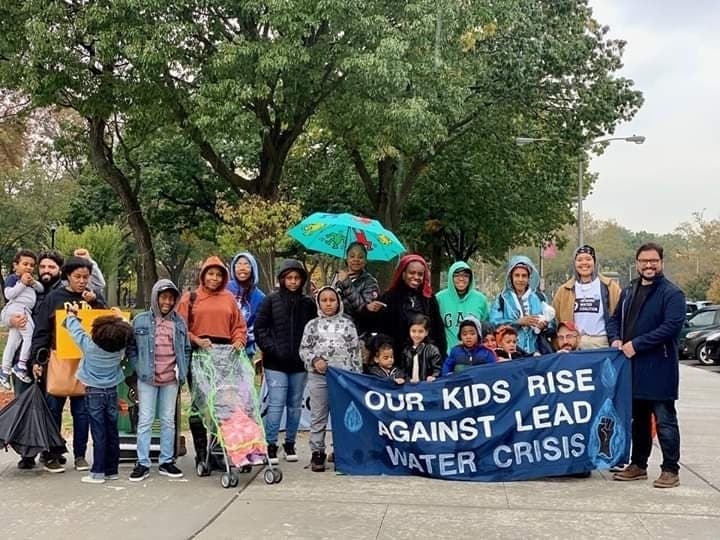
This is an image taken by Shakima Thomas of a rally for clean water in Lincoln Park, Newark, NJ on Oct. 20, 2019.
Children tend to be a focal point of protests because of how many issues affect them the most, and contaminated water is definitely one of those issues. The image shows a group of people who are protesting against the lead contaminated water of Newark, NJ. This image was taken by Shakima Thomas in October 2019 at Lincoln Park in the Central Ward of Newark. We can see that there’s about 22 people pictured here, this includes the adults and the children, and they’re holding a banner that says Our Kids Rise Against Lead Water Crisis. This protest occurred during a time when the water had failed multiple tests regarding the levels of lead and it had become a huge public health problem. This image shows people fighting back against the city, who wasn’t doing much to fix this problem, and they’re putting children at the forefront. For many environmental problems, people protest time and time again and nothing comes out of it and no one seems to care that much. However, once you involve kids people start to turn their heads. This image is a great example of how involving kids in these protests against issues, like lead in the water system, is the way to get people to open their eyes and pay attention to what’s happening.
One thing that really stands out in this image is the banner that’s being presented, Our Kids Rise Against Lead Water Crisis. It’s clearly a large banner and it’s there to make a statement so onlookers understand what this group is protesting against. The banner is notably blue to make it more obvious that this is talking about water and these people made sure to put the letters in capital letters to make it very clear what is being said. The size of the banner alone catches your eye, but specifically placing the word kids in there makes it something that’s clearly a bigger issue affecting a more vulnerable group. Lead poisoning is dangerous and can seriously affect a child’s development, and having safe and clean drinking water is something that kids shouldn’t have to worry about not having. Another part of the banner is within one of the water drops, the fist that’s attached to the Black Lives Matter Movement. Newark’s population is primarily minority groups, and the lead within the water is affecting these groups of people disproportionately. The emphasis on the children and the BLM movement through the banner clearly shows people that the lead being in the water of Newark is a problem across many groups of people. These protesters want to bring attention to the fact that children in general are being affected, and they’re also putting the spotlight on minority children who are the subject of these issues more than many other people.
Another thing about this image that stands out are the people. Those who are in the photograph consist primarily of women and children, and almost every single person in this image is a minority. This comes back to the BLM fist on the banner and we can apply this to the people in the image, majority of whom are Black. The BLM movement was very prevalent at the time and continued to become more popular as time went on and the wrong doings against the Black community became more publicized. The Black community has faced a lot of discrimination on issues surrounding the environment, and the water crisis is definitely one of these issues. Pregnant women and children, especially minorities in lower class housing, tend to be the ones most affected by lead poisoning within the water system, so seeing that this photograph of the protest consists mainly of women and children who are part of the Black community emphasizes this point. Both of these vulnerable groups decided to put their foot forward and show that they’re not staying quiet about the harm that the Newark water contamination does to people. People are the focal point of the Newark water crisis because that’s who this affects the most, and it’s important to pay attention to those who can’t exactly fight for themselves, like children, and fight for them and with them to make a difference in the community.
The last thing in the image that’s notable is the location. At first glance, it doesn’t seem significant because you really can’t see much, but once you learn about the image the location makes it more obvious why it matters. This photo was taken in Lincoln Park, Newark, and this park is situated in the Central Ward of Newark. The central ward is important because it’s one of the wards that was impacted by the lead water crisis the most compared to anywhere else and a large majority of the population of the central ward is part of the Black community. Tying this back into the banner with the BLM fist, the location of this makes even more sense as to why this protest is happening and why we see more Black people than anyone else doing this. The banner outwardly showcases who this issue is affecting, but the location does it more subtly. Having this protest in the central ward pushes for the issue to be loudly expressed and shown to other people who maybe didn’t want to protest themselves or they couldn’t. Doing this in a park in one of the most affected wards was a thought out thing to do and to make an impact you have to do it in the areas it matters most.
This image ties into my project well because of how much it’s showing when you really look at the picture. The Newark water crisis was years of struggle and fighting for the right to clean water for not only themselves but for the children as well. Putting children at the front of this protest and making it about them can turn people’s heads and make them actually take a second to learn about the issue and see how change can be done. This protest spreads into the wider issue of clean water rights and the fight for reproductive rights. Clean water is necessary for children because lead can promote learning disabilities and developmental issues, and it’s necessary for pregnant women because the drinking of lead can promote low fetal growth and even still births. Clean water is a must have thing for people because if the water isn’t clean and this is leading to issues for both fetuses and children it is promoting issues regarding reproductive health and the fight for strong reproductive rights for women and stronger environmental rights for the growing children.