Fire On The Arthur Kill: The Chemical Control Corporation a Time Bomb in Elizabeth, NJ 1980.
by Vincent Binetti
Site Description:
The Chemical Control Corporation plant in Elizabeth, NJ, was a functioning storage facility used for chemical waste in the surrounding areas during the 70s until its closing in 1979. The site is located in an industrial area of Elizabeth and right on the Elizabeth River, which feeds into the Arthur Kill River. During this time, Elizabeth was a city heavily populated by immigrant families from all over, but primarily Western European families. In the year 1980, the facility had exploded, leaving chemical debris from the waste stored there. This was a result of years of poor management and improper handling of extremely dangerous chemcials going unnoticed within its community for seven years. During its life span the chemical control corporation would recieve several fines for illegal dumping and storage violations. While the fire plays a significant part within the sites history it is also important to know about the things that went unnoticed. The Elizabeth river was a clear site of chemical run off within the areas surrounding soil and water. In what other ways were these chemicals bleeding into the community? Why did it take almost seven years for the community to speak up for themselves especially if a majority of the harm had already been done? If the Corporation had received multiple citations for improper management and storage of these dangerous and deadly chemicals why was nothing done sooner to put a stop to the Corporations malpractice?
Lorem ipsum dolor sit amet, consectetur adipiscing elit, sed do eiusmod tempor incididunt ut labore et dolore magna aliqua. Ut enim ad minim veniam, quis nostrud exercitation ullamco laboris nisi ut aliquip ex ea commodo consequat. Duis aute irure dolor in reprehenderit in voluptate velit esse cillum dolore eu fugiat nulla pariatur. Excepteur sint occaecat cupidatat non proident, sunt in culpa qui officia deserunt mollit anim id est laborum.
Lorem ipsum dolor sit amet, consectetur adipiscing elit, sed do eiusmod tempor incididunt ut labore et dolore magna aliqua. Ut diam quam nulla porttitor massa id. Elementum facilisis leo vel fringilla est ullamcorper eget nulla. Orci porta non pulvinar neque laoreet suspendisse interdum. Purus semper eget duis at tellus at urna. Diam maecenas ultricies mi eget mauris. Diam ut venenatis tellus in metus vulputate eu. Ullamcorper morbi tincidunt ornare massa eget egestas. Quis eleifend quam adipiscing vitae proin. Consectetur adipiscing elit pellentesque habitant. Cras fermentum odio eu feugiat pretium nibh ipsum consequat nisl. Lectus mauris ultrices eros in cursus turpis massa. Luctus accumsan tortor posuere ac. Porttitor eget dolor morbi non arcu. Maecenas pharetra convallis posuere morbi leo urna molestie. Neque convallis a cras semper auctor neque vitae. In iaculis nunc sed augue. Suspendisse interdum consectetur libero id faucibus. Sit amet porttitor eget dolor.
Felis eget nunc lobortis mattis aliquam faucibus. At elementum eu facilisis sed odio. Eu facilisis sed odio morbi quis commodo odio aenean sed. Habitasse platea dictumst quisque sagittis purus sit amet. Et ultrices neque ornare aenean euismod elementum nisi quis eleifend. Velit dignissim sodales ut eu sem integer. Morbi tempus iaculis urna id volutpat lacus laoreet non curabitur. Aliquam eleifend mi in nulla posuere sollicitudin aliquam. Nunc congue nisi vitae suscipit. Convallis tellus id interdum velit laoreet id. Turpis in eu mi bibendum neque egestas. Magna fermentum iaculis eu non diam phasellus vestibulum. In cursus turpis massa tincidunt dui ut ornare lectus sit.
Non pulvinar neque laoreet suspendisse. Eros donec ac odio tempor orci. Nullam non nisi est sit amet facilisis magna etiam tempor. Platea dictumst vestibulum rhoncus est pellentesque elit ullamcorper. Eleifend donec pretium vulputate sapien nec sagittis aliquam. Proin fermentum leo vel orci porta. Eget dolor morbi non arcu risus quis varius quam quisque. Nec ultrices dui sapien eget mi proin sed. Nisl nisi scelerisque eu ultrices vitae auctor eu augue. Pellentesque pulvinar pellentesque habitant morbi tristique senectus et netus et. Pellentesque habitant morbi tristique senectus et. Pulvinar elementum integer enim neque volutpat ac. Vel orci porta non pulvinar neque. Laoreet sit amet cursus sit amet.
Pharetra massa massa ultricies mi quis hendrerit dolor magna. Mattis nunc sed blandit libero volutpat. Nec ultrices dui sapien eget. Gravida neque convallis a cras semper auctor neque. Aenean et tortor at risus viverra adipiscing at. Quisque non tellus orci ac auctor augue mauris. Ultrices in iaculis nunc sed augue lacus. Quam elementum pulvinar etiam non. Felis bibendum ut tristique et egestas. Sagittis nisl rhoncus mattis rhoncus. Ac ut consequat semper viverra. Volutpat commodo sed egestas egestas fringilla phasellus faucibus scelerisque. Urna condimentum mattis pellentesque id nibh tortor. Erat nam at lectus urna duis convallis convallis. Malesuada fames ac turpis egestas sed tempus urna et pharetra. Pellentesque diam volutpat commodo sed egestas egestas. Interdum velit euismod in pellentesque massa placerat duis ultricies lacus. Est velit egestas dui id. Pellentesque id nibh tortor id aliquet lectus proin nibh. Id nibh tortor id aliquet lectus proin nibh nisl.
Primary Sources:
Catlin, Mark D. “Chemical Control Site FIre and Cleanup New Jersey 1980 USEPA.” YouTube, YouTube, 2008, www.youtube.com/watch?v=NPgwifGzJRU.
This seems to be the reuploading of a news report from 1980. The video goes into detail of what was needed to be done to the site for it considered to be cleaned this includes soil testing, dredging and ground water treatment. For this source I would like to use this source to go into deeper detail of how the EPA got involved with the site along with explaining the testing that was done on this site by the EPA and State Agencies.
NJ Department of Health. “A Health Survey of Residents of the Relocated Bayway …” NJ.Gov, New Jersey State Department of Health , 1982, www.nj.gov/health/ceohs/documents/eohap/haz_sites/union/elizabeth/relocated_bayway/rb_hlthsurv_rpt.pdf.
This is report done by the NJ Depart of Health and NJIT this is a health report on the residents of the Relocated Bayhead residents a neighborhood near the industrial area of Elizabeth NJ similar to the Site review and update from the NJDEP it also lists the possible conditions many of the residents faced during their time in this neighborhood. I plan to use this report to cover many of the health issues that may have arisen during the time the Chemical Control Corporation Operated.
Time Magazine. “Explosion of a Toxic Time Bomb.” Time Magazine , 5 May 1980.
Explosion of a Toxic Time Bomb https://time.com/archive/6881950/environment-explosion-of-a-toxic-time-bomb/
This is a newspaper from a few days after the explosion with accounts of witnesses including residents in Staten Island who were able to see the explosion. The article also gives us a bit of insight as to how the residents of Elizabeth felt during the run time of the Chemical Control Corporation. The plan for this article is to put into perspective just how bad this fire and explosion was not just in size but also the last health effects it had on first responders and residents in the area.
U.S. Environmental Protection Agency. “Superfund Record of Decision Chemical Control, NJ: First Remidial Action .” EPA, Environmental Protection Agency, nepis.epa.gov/Exe/ZyNET.exe/9100OTY3.txt?ZyActionD=ZyDocument&Client=EPA&Index=1986+Thru+1990&Docs=&Query=&Time=&EndTime=&SearchMethod=1&TocRestrict=n&Toc=&TocEntry=&QField=&QFieldYear=&QFieldMonth=&QFieldDay=&UseQField=&IntQFieldOp=0&ExtQFieldOp=0&XmlQuery=&File=D%3A%5CZYFILES%5CINDEX+DATA%5C86THRU90%5CTXT%5C00000026%5C9100OTY3.txt&User=ANONYMOUS&Password=anonymous&SortMethod=h%7C-&MaximumDocuments=1&FuzzyDegree=0&ImageQuality=r75g8%2Fr75g8%2Fx150y150g16%2Fi425&Display=hpfr&DefSeekPage=&SearchBack=ZyActionL&Back=ZyActionS&BackDesc=Results+page&MaximumPages=20&ZyEntry=1 . Accessed 19 Oct. 2026.
This government document was provided by the NJ DEP. Within the document it discusses the step by step procedures and plan of action to clean the Chemical Control Corporation. It also discusses the effects the site had on the surrounding neighborhoods just across the Elizabeth River. The goal for source is to help explain and expand on how the site affected not only affected residents in Elizabeth. As well as those just across the Arthur Kill in Staten Island as there is most likely a high probability these same chemcials could be found in the soil on the opposite side of the river.
United States, Congress, Rodriguez , Mark. Site Review and Update, Chemical Control Corporation, Elizabeth, Union County, New Jersey Cerclis NO. NJD000607481, vol. 1, Publish Health Service, 1992.
Site Review and Update, Chemical Control Corporation, Elizabeth, Union County, New Jersey Cerclis NO. NJD000607481 compiled by Mark Rodriguez. https://www.nj.gov/health/ceohs/documents/eohap/haz_sites/union/elizabeth/chemical_control/chemcon_sru_9_92.pdf
This is a government document put out as a public health service 10 years after the explosion of the Chemical Control Corporation. This Source includes two maps and reports on contaminated soil and and water run off. I plan to use these maps to help emphasize just how big this facility was in combination with my image analysis to show just how many chemical drums could be stored on these grounds.
The Site Review and Update of the Chemical Control Corporation in Elizabeth NJ released by the U.S. Department of Health and Human Services and compiled by Mark Rodriguez discuss the impact of the 1980 explosion of the CCC site. The site was home to thousands of chemical drums that were being improperly stored and illegally dumped along the Elizabeth river feeding into the Arthur Kill river. A plethora of Government agencies were tasked with the clean up of this site such as the EPA, the DOH, the Agency for Toxic Substances and Disease Registry all issuing multiple health assessments for the first responders, residents and local environment surrounding the area. While all of this is helpful 12 years after the fact it brings up the question as to why was the CCC able to go about this improper practice for several years without questioning from county or state officials and just a few fines that act as a slap on the wrist. With this document we are able to form the argument that much of what was happening at the Chemical Control Corporation was being hidden to residents of Elizabeth as the site was hidden in plain sight due to it being mixed with other industrial factories seen on the map.
It was not until 1977 that many of the residents of Elizabeth started to voice their concerns with the Chemical Control Corporation the report states “Community concerns date back to 1977 and came to a peak in 1980 because of the fire at the Chemical Control Corporation site. Residents expressed concerns about the potential health risks and environmental degradation of the site and the nearby Elizabeth River”(Rodriquez pg. 3). Although the reaction was delayed the community was facing possible health risk for seven years which is a lot of time for any diseases caused by this factory to fester and worsen. A lot can change environmentally speaking in seven years as well. While the area is entirely industrialized that does not mean there are no ecosystems possibly living in those waters along with chemicals infiltrating water filtration sites for not just Elizabeth but the entirety of Union Country.
Figure 2 within the report which will be figure 1 within this document is a map of the industrial area and home of the Chemical Control Corporation. On the map there are several roadways and the Elizabeth river. While it is known that illegal dumping occurred on the river, there were most likely multiple trucks moving through this industrial area. With that being said there was presumably a high probability that many of these trucks happened to be the cause of spillage during the transport of chemicals across the Goethels bridge and just throughout the local road ways. The Departments and Agencies worked relentlessly to try to contain the environmental impacts performing a multitude of test some including the testing of the ground water, surface water and soil from the surrounding area stating “When implemented, the treatment process will solidify the contaminated soil However, environmental data showing current contamination levels in subsurface soil, groundwater, and surface water and sediment from the Elizabeth River are not available”(Rodriguez pg. 4-5). The testing of surface water and groundwater are essentially futile after 12 years as both are moving bodies of water that mostly have spread and dispressed among a greater area not just staying at the superfund site. The only effective testing that could have been done would be the test done on the subsurface soil and sediment. However, once again those are faced with 12 years faced with general change and change in weather conditions which could also skew the results leading to them being unavailable.
Secondary Sources:
Gates, Alexander, and Robert Blauvelt. “Encyclopedia of Pollution.” Encyclopedia of Pollution, Facts on File, 2011, pp. 112–115.
Ledbetter, Les. “Chemical Dump In Elizabeth Hit By Another Fire: 3 Firefighters Treated.” New York Times, 6 June 1980, pp. 1–1.
Lesniak, Ray. “On April 20, 1980, the Chemical Control Explosion Changed America.” NJ Insider, 24 Apr. 2021, pp. 1–1.
Image Analysis:
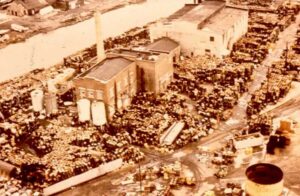
Chemical Control Corporation Birdseye View via Facebook Post by Rick Degroot April 2026
The image I will analyze is a birdseye view of the Chemical Control Corporation. Much of the history behind this photo is unknown such as to who captured the image and when it was produced. However due to the state of the buildings and the drums littering the area we can infer that the image was produced before the fire in 1980. I was able to locate this image from a Facebook post made in April 2026 posted to a group called Building Construction for the Fire Service. While the post has an intended audience for members of fire protection services the image itself could have been intended for locals of Elizabeth NJ or the surrounding area of Union County NJ. While it is evident that pollution was easily spread via the river due to the site’s location that alone was just one way the chemical run off happened. As trucks and heavy machinery would run through the site daily transporting these harmful chemicals it is very possible that spillage occurred during transportation and possibly being picked up by the tires to spread throughout the area unknowingly. The Chemical Control Company bled poison into a community unable to properly stick up for itself composed heavily of working class and immigrant backgrounds.
The first and most obvious way the Chemical Control Company was able to cause such damage to the residents of Elizabeth is via the Arthur Kill river seen in the top left part of the photo. It is easy to infer that plenty of illegal dumping was being done here simply out of the convenience of it. Even if the corporation was not physically the ones doing the dumping the drums were left outside exposed to the environment and being paired up with any of the chemicals that were known to be stored on site this was a recipe for disaster. Due to this the drums can easily deteriorate with time causing the chemicals to seep into the ground contaminating the top soil, water run off from rain or snow, and bleeding into the Arthur Kill. Due to the site’s location it is very easy for something like this to go unnoticed as the Arthur Kill feeds into the Hudson River which has been polluted for years.
As for the next example it would be best to point out the giant vats surrounding the warehouse, specifically the ominous one in the bottom right corner of the photo. Looking at this part of the image it immediately raised some concerns as it is seemingly an open container that can easily let off disastrous fumes completely unregulated. Based on its size alone this looks as if it could store hundreds of gallons of chemical waste and disposal. Once again being exposed to the chemicals one hot day in the summer this container could easily let off enough fumes that the neighboring city of State Island could smell it. For this to not be flagged by any State or Government EPA for several years is genuinely concerning especially for a container of that size.
Lastly a method of pollution that could go completely unnoticed is the dirt road running throughout the photo. With chemical run off and chemicals bleeding into the top soil so easily the contaminated soil could easily have been picked up by any truck simply doing its routes within the grounds. The reason this is such a big issue is because that same soil can be brought out to the rest of the city to contaminate any soil it comes in contact with. Something this small can easily go unnoticed and wreak havoc on the local flora and fawna even though the location of the Chemical Control Corporation is located within a city it still contains greenery like public parks and cemeteries.
This image can only be described as greed, the Chemical Control Corporation kept on taking on customers when the facilities clearly could not handle and maintain the main function in its name “Control”. The Chemical Control Corporation was silently poisoning a voiceless community via several pathways: land, water, and the air they breathe. The residents of Elizabeth were unjustly exposed to toxic waste for several years unknowingly detrimentally affecting the health of the lower class immigrant community that inhabited Elizabeth during this time.
Resources
Degroot, R. (2026, April). Fire in chemical waste storage facility injures dozens of firefighters – Chemical Control Corporation Fire – Elizabeth, New Jersey – April 21, 1980. Facebook. October 2026, https://www.facebook.com/groups/192218352449074/posts/1508806284123601/